
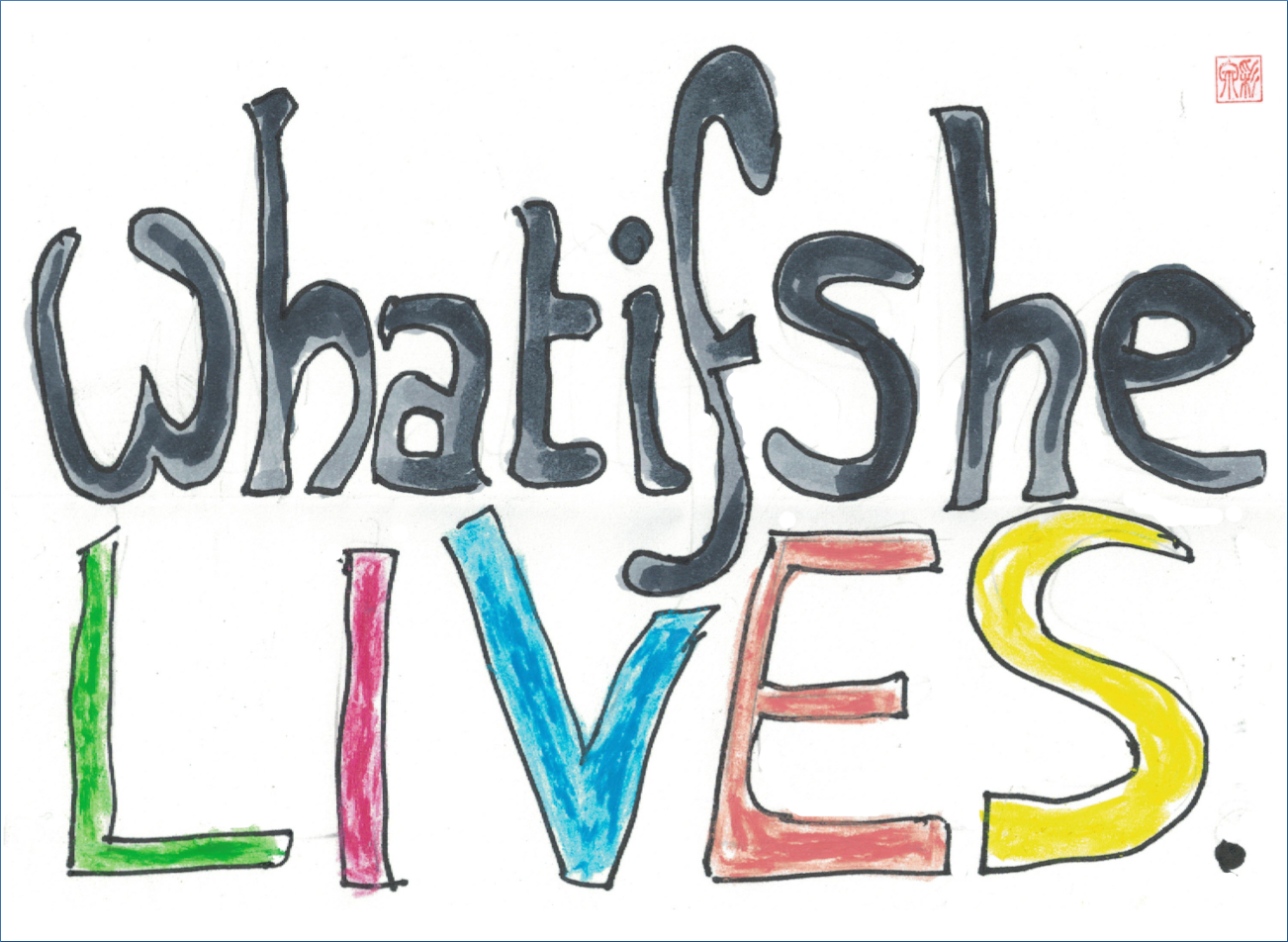
New Campaign #whatifsheLIVES.
-
Introduction
-
#whatifsheLIVES.
-
Examples: Almila Akad and Andrea Hofer (German tv m ovie: FACKEL / TORCH)
-
Conclusion
Today I’m launching my new campaign, three years after #swaptheadjectives (20 June 2023), six years after #morethanCorpses (12 February 2020) and nine years after #Open Eyes Stereotypes (16 February 2017):

Introduction
The catalyst for my new campaign was the Frankfurt episode of German top cop drama Tatort / Crime Scene titled FACKEL / TORCH, broadcast on 22 March. Once again, women had to die in a TV crime drama without this being dramaturgically necessary for the plot. On the contrary, had the two remained alive and thus been less stereotypical and one-dimensional, the story might well have gained depth and relevance, leaving less room for prejudice and conspiracy theories.
Why do crime writers often think of nothing better for female characters than to kill them off? And no, it’s not a problem if writers can’t develop good female characters – but ideally they should then bring in a competent female co-writer or seek dramaturgical advice (for example through VEDRA, the German Association for Film and Television Dramaturgy).
You could also simply try out my new suggestion and, either on your own or with a group of interested people, conduct a #whatifsheLIVES. brainstorming session to improve the character. This involves looking for alternative plot developments and storylines for female characters who, according to the treatment or script, are supposed to die.
#whatifsheLIVES.
What if a character does not die? What happens instead? What might need to happen differently beforehand?
The starting point is, first and foremost, a death that no longer takes place. From there, the narrative is developed backwards in time, or rather, the character’s existing storyline is scrutinised.
Perhaps she survives the suicide, murder, attempted murder or accident? What if the attempt never happens in the first place – what course of events would need to be altered? Was there already a moment that didn’t quite fit with the subsequent death, where changes could be introduced? To what extent does her new ending – her continued living – affect her actions, characteristics and needs? What does this mean for other characters and other plotlines? How early on in the story must changes be introduced? These are just some initial ideas.
The new campaign is aimed at writers, commissioning editors, directors and actors.
When you’re developing your stories, ask yourselves this question for every woman you have die: what if she lives. Come up with at least one alternative storyline with a different ending. When you’re presented with or offered new material in which women die, consider each one with an open mind: what if she lives. Discuss the question within your team, with the editorial team, and with the director. If you are asked to play a ‘dying role’, consider by yourself what if she lives, and whether there is a way to discuss this with the production team or director. (I know, especially with small roles, this really isn’t easy!).
If, in the end, you’re more convinced that the character should die, then so be it. But if it makes more sense for her to live and that improves the story, making it more exciting, more complex, more surprising, then rewrite the script or treatment accordingly, or have it revised.
Dead women aren’t sexy. And a crime drama isn’t necessarily better for having more female corpses.
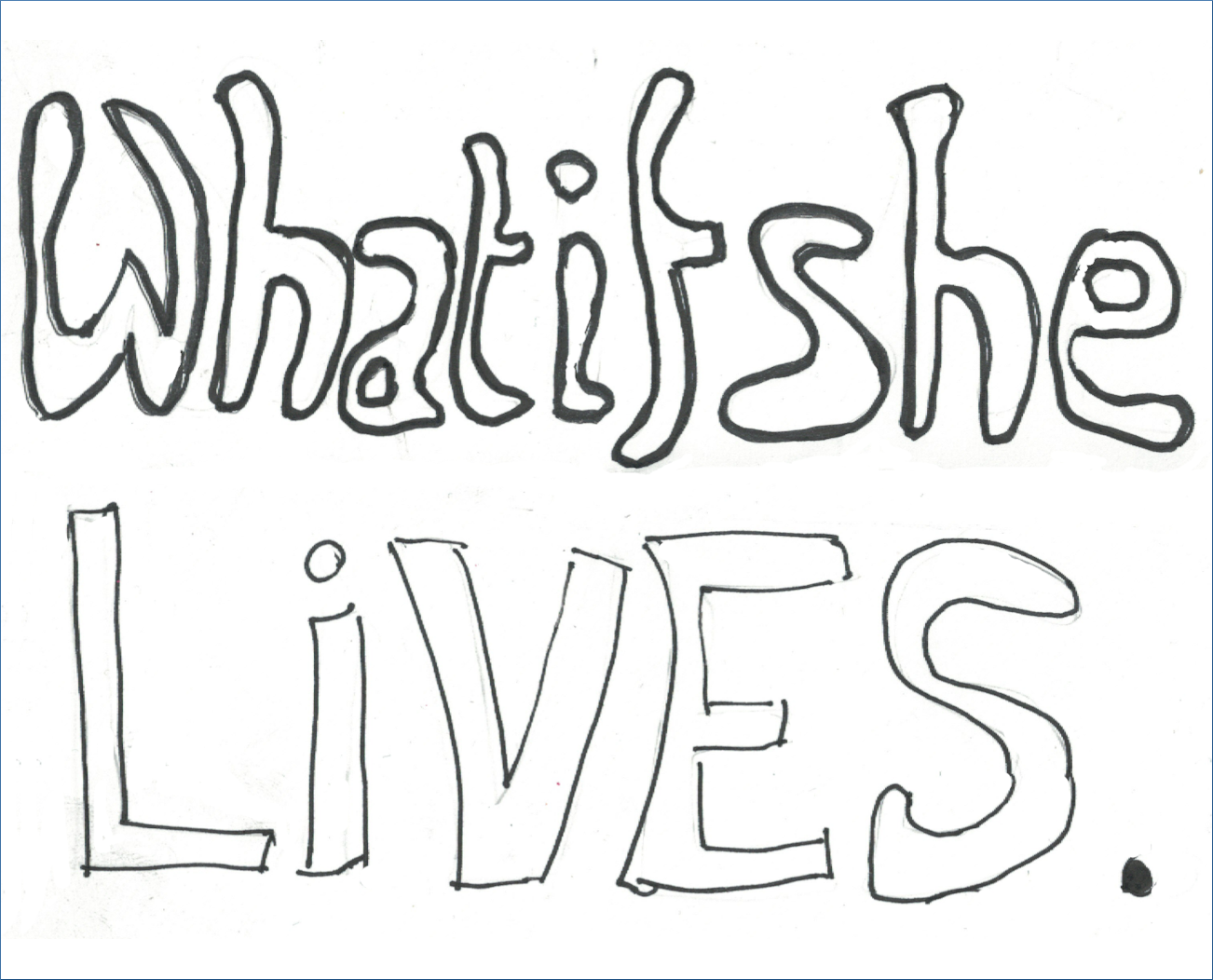
Here is the campaign visual in colour, and in black and white for you to colour in yourself. Perhaps you’d like to print out the card? Then you can place it on your desk or hang it on the wall in your office or wherever you write or read your screenplay. Use the card to question every death of a woman in the crime drama or film project, especially that of less developed supporting characters. It can actually be quite fun!
I also offer talks and workshops on #whatifsheLIVES for the industry and beyond. (Experstieve – Equality & Diversity.)
Examples from a TATORT (Crime Scene) tv movie
To illustrate this, here is a quick #whatifshe’sALIVE brainstorming I did for the two dead women in the aforementioned Tatort episode FACKEL (screenplay by Sebastian Heeg and Tom Schilling):
- Almila Adak. Suicide by setting herself on fire.
- Andrea Hofer. Presumed murdered, presumably staged to look like suicide; found naked in a bathtub filled with water and blood.
What happens in FACKEL?
Years after a devastating high-rise fire that claimed thirteen lives, Chief Inspector Hamza Kulina (Edin Hasanovic) bumps into his ex-girlfriend at a vigil. Almila (Seyneb Saleh) lost her mother in the blaze and has been fighting tirelessly for justice ever since. The high-rise block of social housing was engulfed in flames within minutes – possibly due to cheap insulation material that had been installed in breach of regulations. When an inquiry committee set up to hold those responsible to account threatens to end without results, Almila asks Hamza for help. The investigation leads Hamza Kulina and his colleague Maryam Azadi (Melika Foroutan) from a mysterious death to the managing director of a building materials group, (Stephan Luca), who has close ties to the political world. But the closer the detectives get to the truth, the greater the danger becomes – for their investigation and for themselves.
(Source: ARD press kit. Square brackets and colour/bold text added by me)
What’s FACKEL about?
Democracy and the checks and balances do not work. The rich buy influence over politics, the police and the judicial system, and put pressure on ordinary people. And they get away with it. The few who rebel against this system are driven to their deaths or give up. The fourth estate (the media) remains inactive. There is no justice.
How does FACKEL end?
The case is resolved at the very end with a bit of a bland trick. Inspector Azadi interrogates the wife of the businessman, Simone Böttcher (Katharina Heyer) and in doing so brings up the Böttchers’ personal connection to the materials expert Beetz and to Chief Detective Inspector Möller (Michael Schenk) – a connection which is mentioned for the very first time). In true TATORT style, the investigation also flouts the rules (e.g. DNA matching: Azadi secretly steals a scarf from the Böttchers’ flat). Her colleague Kulina grumbles about police work and the legal system, without drawing any conclusions from it.
It doesn’t seem as though the story was preceded by any thorough research, for example regarding the work of parliamentary committees. But that’s another matter.
And now, finally, the two women who had to die in FACKEL:
Almila Adak (Seyneb Saleh)
A survivor. Her mother, Cemre Adak, and twelve other people died in a Frankfurt high-rise building fire five years ago (the ‘Goliath fire’). Investigator Kulina says of her mother: ‘She had only Almila and sacrificed everything for her.’ (?)
Almila Adak runs into her ex-boyfriend, Inspector Kulina, on the sidelines of a vigil organised by the bereaved, just a few days before the committee of inquiry into the Goliath fire is due to conclude its work. Adak mentions that a trial had already taken place – though it remains unclear who sued whom, how long the trial lasted, and what the outcome was. According to her own account, Adak was present at this trial every day, though not as a joint plaintiff (which she could have been as a relative), but merely as a member of the public. She made audio recordings throughout the trial – or presumably only during the public sessions – which is prohibited under Sections 201 and 201a of the German Criminal Code (StGB), but apparently nobody in court noticed. Adak subsequently transcribed the audio recordings by hand (!). She had already noticed various inconsistencies during the trial – “There are so many unanswered questions that were not addressed in the trial” – but apparently did not share these with anyone, nor did she point them out to Kulina when she handed him her folder containing the originals.
The inquiry committee was set up five years ago and is still in session. (Although it is sometimes referred to as ‘five years’ and sometimes as ‘for several months’). The findings are due to be announced ‘in three days’. ‘Today’, on Tuesday, another witness is due to give evidence: Steffen Böttcher, managing director of Styvex, a building materials group that sells the insulation material which contributed to the devastating fire. (It is somewhat surprising that he is not appearing at the start but only at the end of the committee’s work, isn’t it? It is also astonishing that, in the final image from the committee, he is sitting at the committee’s round table with his lawyer – as a non-MP?)
Almila Adak is “determined not to give up until all those responsible for this senseless tragedy have been held to account”. She and other bereaved relatives are protesting outside the parliament building where the committee is meeting and are verbally confronting Böttcher. Over the next two days, the Senator for Urban Development and relatives will be heard, before a closing press conference takes place on Friday at midday.
There is no description of what Adak’s ‘tireless fight for justice’ has looked like over the past five years. What else she does, how she makes a living – we do not know. Only that she apparently has no access to a computer – see the handwritten transcripts – and little money (the wad of cash she sent to Kulina shortly before her suicide is said to be all she owned – I reckon that was perhaps €500. Or more?).
It is surprising that, over the past five years – at least since the trial ended – Adak has never spoken to her friend Kulina, who after all works for the CID, about the matter, particularly the inconsistencies. Only now does she ask him for help. Fortunately, Kulina and his colleague Azadi from the Cold Cases Unit have absolutely nothing else to do at the moment, and can therefore spend at least three days going through Adak’s notes and other collected documents, interviewing suspects and witnesses, and so on.
On Thursday evening, Kulina and Azadi have a meeting with their boss, Sandra Schatz (Judith Engel). They want to have Mrs Böttcher arrested, and Mrs Schatz is to inform the public prosecutor’s office. It’s not possible, she says: “The public prosecutor in charge has been transferred. The Ministry of Justice will appoint a successor on Monday at the earliest.”
Side note: That’s actually complete nonsense. All public prosecutors have stand-ins – for when they’re off sick, on training courses, transferred, or whatever. I found this out – and more – by simply phoning the Frankfurt Public Prosecutor’s Office and asking; I spoke to a prosecutor who was standing in for another one (the one I’d intended to call). But back to TATORT.
Kulina rants: “If the judiciary is blocking our work to cover up a scandal, then I’ve got a big problem with that!” (It’s also funny that the very next morning, when there’s supposedly no competent public prosecutor, Kulina and Azadi arrest Ms Böttcher. But never mind.) He solves the problem by telling his girlfriend Akad “the truth” over the phone, namely: “That this whole thing is one massive corrupt piece of shit. And that sometimes there is no justice.” Somewhat surprising, given that the rapid investigations have led to the conclusion that Ms Böttcher – together with Chief Inspector Möller – murdered the building materials expert Beetz five years ago (murder is not subject to the statute of limitations!) and disguised it as suicide.
After Kulina’s phone call, Almila writes on a piece of paper in her flat: “Those who have no voice have only action left.”
A little later, Kulina brings her back the folder containing the original documents. She hands him a letter: “Promise me you won’t read it until tomorrow evening.” He promises, but of course he reads it sooner, the following morning – Friday: “By the time you read these lines, I will be gone. I’m sorry if I’ve caused you any distress over the last few days (?), but I wanted to leave no stone unturned. Give the letter with the statement to the press.” (It’s also in the envelope, along with the banknotes mentioned; those are for the bereaved families’ initiative)
Akad sets herself on fire in front of the entrance to Styvex. There’s not a soul in sight. Unfortunately, no one sees her sitting down on the ground, pouring petrol over herself and going up in flames either (no doorman, no CCTV cameras?). Kulina has a hunch that she will be right there; after reading her letter and not finding her in her flat, he rushes to the Styvex building. He arrives too late; she is already dead.
Final scene: Azadi and Kulina each place a flower on the graves of the two victims, Cemre and Almila Akad. We do not see whether Hamza Akad’s statement and money reach the intended recipients as requested.
This is, of course, a difficult situation for Almila Adak (or rather, the actress playing her, Seyneb Saleh). As a “great fighter for justice”, she is expected to make it credible that she was not a joint plaintiff in the trial, that for five years she did nothing more substantial than hold vigils and light candles at the grave (?), and that she spoke neither to a lawyer (!) nor to the prosecution (wasn’t there a trial, after all?). Nor does it appear as though she, as a bereaved relative, was given a voice during the trial or in the parliamentary inquiry. At least, this is not mentioned. It also appears that Adak did not speak to any (opposition) politicians, even though a house fire, exacerbated by faulty building materials and its consequences for the environment, would be an issue for the Greens, and the power of corporations something for the Left Party, which is represented in the Hessian state parliament. Adak and presumably other bereaved relatives also do not seem to have spoken to critical or other journalists. Were there none in Frankfurt am Main?
So much for the (non)action. But now!
If Almila Adak doesn’t die at the end of this cop drama, what could have happened instead? #whatifsheLIVES.
Here are a few ideas:
- Just as Adak is about to set herself on fire, he is saved at the last second by Kulina. Conveniently, Kulina has a fire blanket in his pocket (it had been left anonymously for him at his mother’s house); he smothers the rising flames and calls the fire brigade. He is so distraught that he storms into his boss Mrs Schatz’s office, slams his police officer ID and service weapon down on her desk (professional cliffhanger!) and then sits by Adak’s hospital bed, silently holding her hand (personal cliffhanger!). End titles.
- Adak is rescued at the last minute by the porter at the Styvex building, who had spotted her on the CCTV monitor; she is taken by helicopter to the Ludwigshafen Centre for Severe Burns (Frankfurt does not have one). After that, there are various possible outcomes, including in relation to the media and the parliamentary inquiry.
- As mentioned, Adak writes “Those who have no voice have only action left” on a piece of paper. But she isn’t planning to kill herself; instead, she’s making Molotov cocktails (at the same time as the investigative committee’s final press conference). She packs the incendiary devices into her rucksack and cycles off. Where to, who knows? End credits. (For this to happen, Adak would, of course, need to be portrayed as less passive and more combative beforehand.)
- Adak has no intention of committing suicide; her ‘action’ consists of appearing before the press alongside the victims’ families’ initiative and bringing to light inconsistencies in the trial as well as the new findings from Kulina (re: Beetz and Möller).
- Adak has no plans to commit suicide; instead, she goes to a lawyer who is a friend of hers or who has been recommended to her, in order to file a complaint against Styvex, the managing director Böttcher and his wife, as well as KHK Möller.
- Adak is not planning to commit suicide but storms into the press conference for the final report of the inquiry committee. She has prepared (handwritten!) statements to be read out and distributed, in which she names Kulina and Azadi, outlines their investigations and names Styvax / Böttcher and Müller as the perpetrators. She accuses Kulina just as much as ‘the system’ (an intriguing breach of trust! Which makes sense, because why hadn’t she been in contact with him even once in five years?) She is supported by other bereaved families from the initiative. Tumult in the committee, the opposition berates the government, a voice-over by a radio commentator, and above it text listing the outcomes of the trials against the two Böttchers, Hofer (see below) and against KHK Möller. Optional: disciplinary proceedings against Schatz, Kulina and Azadi.
Almila Akad could, in this way (proposals 1 and 2), at least escape the trap of perpetually being the victim, or (proposals 3 to 6) become a far more interesting and credible character (see ‘tireless fight for justice’). And the entire TATORT series could move away from the conspiracy narrative that “the state and the media cannot be trusted, all institutions are corrupt and evil, but there is nothing we can do about it”.
The second woman who dies in FACKEL is:
Andrea Hofer (Nadja Bobyleva)
She is a laboratory technician in materials testing; her colleague Rainer Beetz had tested the (insulation) material Polysterol and drawn up a false safety report, if I recall correctly, several years before the Goliath fire. Hofer was still his assistant at the time; she may have helped him with the false report or at least been aware of it.
Beetz had allegedly taken his own life six months after the expert report was issued. That in itself would be suspicious and should call into question the approval of the building material, but it seems to have had no impact on the alleged trial or the work of the inquiry committee. And now, thanks to the investigations by Kulina and Azadi, it has emerged that it was not suicide but that he was murdered.
To start from the back: Hofer was asked by Azadi and Kulina to come to the police headquarters the next morning at 7 am (!) for questioning (as a witness?). Now, the fact is that she doesn’t have to go there at all, nor does she have to cancel. But Andrea Hofer probably doesn’t know that. (Source: fachanwalt.de)
In any case, she doesn’t turn up for the appointment while Azadi and Kulina are waiting for her. Kulina says, “I’ll send a patrol to her flat.” (Why? She’s under no obligation to attend.) It must be around half past seven or quarter to eight by now. Why does he assume that Hofer is in her flat and not already at work or on her way there? Next, we see two police officers breaking open Hofer’s door lock and storming into the flat. Hofer is lying dead and naked in the bathtub (female corpses are often shown naked in German crime dramas, and sometimes in water, but that’s another matter).
What had happened beforehand? Hofer had been ‘visited’ in the lab by Azadi and Kulina and questioned about Beetz. Later, she received a summons to attend an interview/interrogation at police headquarters the following morning. Hofer immediately texted Styvex boss Steffen Böttcher, who met her a little later in his car. (Very clumsy, by the way – hello, evidence!) Among other things, he says: “In your case, the public prosecutor’s office will charge you with bribery and manslaughter in 13 cases.” He addresses her informally, she addresses him formally. She is completely terrified and overwhelmed, just as she had already seemed extremely nervous in her previous encounters with Kulina and Azadi. Böttcher says: “Styvex will always support you generously; you can rely on me one hundred per cent.” She replies: “It’s not about the money. I can’t live with the guilt any longer.” Why is she saying that? It’s foolish, because he has far more to lose than she does and will see it as a threat. Or does she trust him, perhaps? Unlikely. She could at least sense how dangerous Böttcher and his people are.
After the meeting, Hofer goes home; a car is already waiting on the opposite side of the street, from which she is being watched. As she enters the house, someone follows her inside. Shortly afterwards, the police supposedly ring her doorbell. In reality, it is someone who kills her and stages it to look like a suicide in the bathtub.
If Andrea Hofer Adak isn’t found dead and naked in the bath in the end, what could have happened instead? #whatifsheLIVES.
- Hofer is not killed but abducted. From the ‘villains’’ point of view, too, it makes more sense for her to vanish from the scene without anyone knowing exactly what happened. The suicide in the bathtub – especially following Beetz’s alleged suicide – would simply be a clear indication that there was something wrong with the material testing report at the time. The kidnappers could send a fake message to Azadi / Kulina: ‘Sorry, I have to go away for a week for urgent personal reasons; I’ll get back to you afterwards’. And if there is still enough time in the episode, we could see the kidnapped Hofer trying to escape or negotiating with the guards. That would also provide an opportunity to clarify plot ambiguities – then not everything would have to be crammed into the Azadi-Böttcher interrogation.
- After meeting Böttcher in the car, Hofer flees without going home again. She is seen boarding a night train to Zurich at Frankfurt Central Station.
- After meeting Böttcher, Hofer goes to her boyfriend, who is a security guard at a trendy nightclub, and browses job vacancies in Austria online. The next morning, she calls in sick and goes back to bed with her boyfriend.
- Andrea Hofer’s aunt is a public prosecutor in Darmstadt (or her brother works in the archives of the Frankfurt Public Prosecutor’s Office). She calls her/him to ask how the leniency scheme works, as she wants to turn herself in and testify against Steffen Böttcher. They arrange to meet the next day, and Hofer is advised not to go home but to spend the night in a hotel. (The connection to the public prosecutor’s office wouldn’t be any more of a coincidence than if Azadi were to casually mention during Mrs Böttcher’s interrogation that Beetz attended the same sports boarding school as she and her husband. Or worse still: that the corrupt inspector Mr Möller just happens to know Mrs Böttcher from the horses farm. How does Azadi actually know all this? It was never hinted at before (Horse posters on Möller’s pinboard? A group photo from the sports boarding school at the Böttchers’ in the bathroom?). Or did I miss that? Mrs Hofer is a bit of an unknown quantity. It would have been more plausible – and less confusing for the audience – to have a related public prosecutor turn up instead.
- Hofer doesn’t open the door when he rings the bell. Instead, she calls the police and asks if they’ve sent anyone. “No. Don’t open the door. Shall we send someone round?”
- The intruder’s entry – or the attempted murder – wouldn’t exactly have gone off without a sound. Perhaps, just as the ‘policeman’ enters her flat, there is a scuffle; a neighbour knocks on the wall shouting ‘what’s all the noise about?’ or kicks the door in (it wouldn’t just be Kulina who could do that); the ‘policeman’ flees, or Hofer runs away, for example to her burly bouncer boyfriend.
Such variations could help make Andrea Hofer less one-dimensional and passive. For in FACKEL, she is primarily the frightened mouse, the victim. It would therefore be all the more surprising – and satisfying – if she were suddenly to fight back and seek help from others. This would also give the whole story a chance to be better than this accusation that ‘all bad guys get away with it’.
By the way, I’ve read several reviews of FACKEL in which Akad’s self-immolation was described as unnecessary or something similar. Online comments often referred to an “impressive” or “powerful ending” (?!). Hofer’s murder wasn’t mentioned at all. In the Stuttgarter Nachrichten’s Tatort quick review, the “number of bodies” for this episode is given as 15. So 13 from the Goliath fire, plus Beetz and Akad? What about Hofer?
Conclusion
The more I think about #whatifsheLIVES, the more positive and exciting I find the approach. It works well for the character, who doesn’t die and can gain new depth – which, incidentally, is also great for the actress, as it allows her to explore even more facets of her role. And it benefits the whole film, as there are fewer corpses in the end, and instead more characters with potentially better storylines of their own (which go beyond ‘victim, dies’). Furthermore, the core of TATORT may be challenged and improved by the transformation of a character. (Or even the transformation of several characters. I’m just imagining the FACKEL TATORT episode with Akad and Hofer no longer the passive victims they were written and directed as. Directed by Rick Ostermann)
Even if, in the end, the fundamental change doesn’t happen and the character has to die, the #whatifshelives-process alone can be worthwhile.
I’m already looking forward to the first #whatifsheLIVES workshops, where we can develop and consider new ideas for the character who is now continuing her story. (Contact)