This is a quote from screenwriter Dorothee Schön (-> official website in German), who wrote an internal letter in April to the—male—members of the German Screenwriters’ Association (Deutscher Drehbuch Verband DDV). With her kind permission, I am publishing the letter today—thank you very much!
You’ll find it in the second part of this text . But first, a brief look back at the dire situation regarding the participation of female writers in German film and television.
Where are Male and Female Writers (not) Working?
Eleven years ago, I published an article titled It’s the Men that Write the Scripts, in which I highlighted the strikingly male-dominated distribution of authorship in German film and television, using selected statistics and film categories. I usually focus on the percentage of women, but this time I chose to display the percentage of men—which was quite overwhelming:
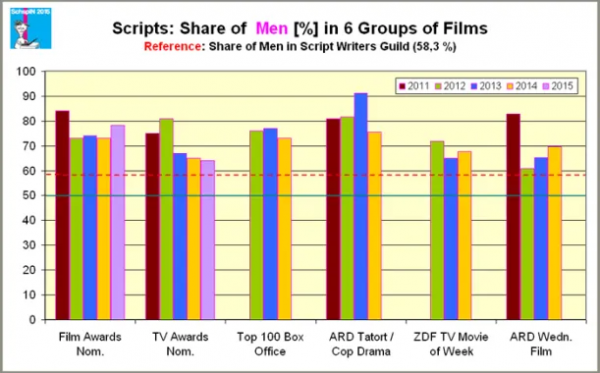
One would think—or hope—that figures providing irrefutable evidence of problems would trigger reactions within the industry and help bring about change; but no, that doesn’t seem to be the case, and even when it does, it happens at a snail’s pace.
The proportion of male members in the Screenwriters’ Association served as a benchmark: 58.3 per cent. I more often use the proportion of women amongst screenwriting graduates from German film schools: 48 per cent. This is according to the FFA’s 2017 study ‘Gender and Film’ – I am not aware of any more recent official figures. Nor do I have any for the Screenwriters’ Association; in 2014 (!), the proportion of women was 41.7 per cent out of 484 members. Today, the DDV website lists 535 members.
Let’s also take a look at the registered screenwriters in the freelancer database of crew united. Vincent Lutz (crew united) explains:
These figures refer to active members (Basic and Premium). I don’t think it makes much difference whether someone has a paid profile (Premium) or a free one (Basic).
Unfortunately, we don’t have exact figures on film professionals in Germany, so we can only assume that perhaps around 50–70 per cent of them have a profile with us. It might even be more.
There are currently 342 female screenwriters and 412 male screenwriters, representing a female proportion of 45.4 per cent – a significant increase compared with 2014:
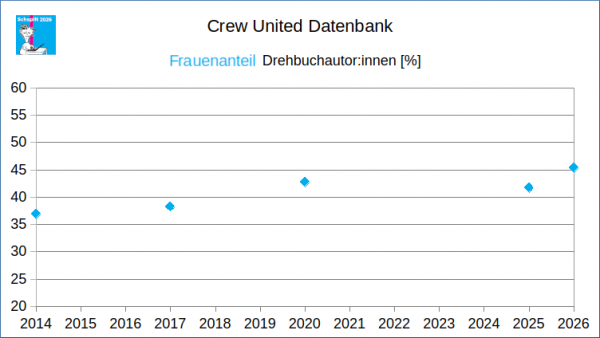
data base crew-united.com. share of women of all script writers [%]
Not that anyone would use this as an argument: the low number of female writers in German television is therefore not down to there being too few of them with professional experience.
Female Writers Pen Letters
In 2019, I carried out a six-departments-check of the *TATORT* episodes from 2011 to 2018 (Crimes from a Male Perspective), which I expanded to include an analysis of *POLIZEIRUF*. These facts in black and white – or pink and light blue on white – provided welcome arguments for a group of female screenwriters who, in early April 2019, sent a ‘Crime Scene: Screenplay’ letter, initially signed by 76 of their colleagues, to the then ARD Programme Director Volker Herres, the directors of the regional ARD broadcasters, the broadcasters’ equality officers and the broadcasting councils. It began as follows:
“(Public broadcaster channel one) ARD is, thankfully, making a voluntary commitment to increase the proportion of women directing fictional TV programmes. But what about the proportion of women in screenwriting? This has been declining at an alarming rate over the last three years!”
The female authors called for a “50/50 cross-format screenplay quota by 2021” and announced the “launch of a round-table discussion to draw up a joint action plan for 2019 to 2021.”
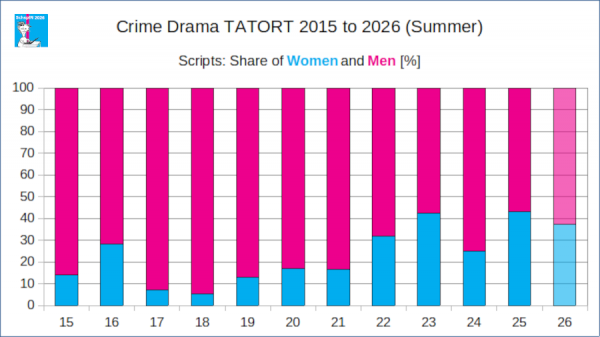
As far as I know, the round-table discussion with the ARD broadcasters never took place. As for the 50:50 distribution of commissions, well, I can say – at least as far as *Tatort* is concerned – that gender parity among writers was not achieved by 2021, nor by 2025. The 30 per cent mark was only exceeded in 2022, but by 2024 the figure had already dropped back to 25 per cent. In 2026, up until the *Tatort* summer break (during which the ARD airs old episodes), the proportion of female writers on this series stood at 37.5 per cent. Experience suggests that this figure is likely to fall further by the end of the year. Oh, and only four of the 16 new *Tatort* episodes in 2026 were written without any male involvement. Thanks to mixed teams, female writers were involved in half of the *Tatort* scripts. However, that does not yet amount to parity. Male writers contributed to 12 out of 16 scripts.
Also in 2019, female screenwriters in the UK began their open letter to UK TV drama editorial teams by expressing their dissatisfaction, as it were:
“In recent years, a new tradition has taken hold amongst us female television writers. It begins when a broadcaster announces its drama commissions for the coming season. A list of promising projects: some will become new audience favourites, others will be flops, and still others will, for some mysterious reason, never quite make it to the screen. But there is no doubt that the vast majority of them will be written by men.”
As I wrote in the blog post ‘Why aren’t You working with Female Screenwriters?’ dated 17 April 19, in which you can also find the full letters from the female screenwriters:
At first glance, the British women screenwriters’ letter seems very restrained compared to the ‘Crime Scene: Screenplay’ letter, but thanks to its multi-stage approach, the supportive involvement of the screenwriters’ association WGGB, and the subsequent direct discussions with editors and others in smaller or larger groups, it really gained momentum after a short time.
I have enquired with the WGGB about the current status. As soon as I have a reply, I will add it here.
Edit 14.8.20: „We need to Keep Working!“
Lisa Holdsworth, who is now Chair of the TV Committee for the WGGB replied to me today:
We’re about to launch a follow-up to our Equality Writes campaign. We’ve found that after promises and assurances about better opportunities for female writers in drama and comedy, very little changed. And as the industry has contracted the same white male writers are being commissioned over and over.
Indeed, it’s a standing joke that the WGGB’s president – Jack Thorne – only has to sneeze and he gets a commission! However, he is a great supporter of our campaigning – so we try not make him feel too bad.
Things came to a head when the BBC announced they had commissioned a factual drama about the murder of Sarah Everard by a serving UK policeman. It was a significant case because it brought the scale of violence against women into the spotlight. So, when the BBC announced that a man -Jeff Pope – would be writing it, there was some disquiet amongst female writers. That turned into anger and in 24 hours 400 writers had signed a letter asking for the BBC to look at how they commission drama about women’s issues.
The WGGB were involved in discussions with the BBC but it reinvigorated our determination to relaunch the campaign. This time we’re going back to the commissioners with a checklist of things they promised to do for equality and other actions we feel they could take.
So, in short, I think there was some progress initially but we need to keep working!
Female Writers Launch a Report
A few years after the *Crime Scene: Screenplay-Letter… we had Covid, yes, but that’s not what I’m referring to here; rather, I was commissioned by the writers Kristin Derfler and Annette Hess to carry out an analysis of German TV series productions (which they funded out of their own pockets). The study was published on 16 May 2022,
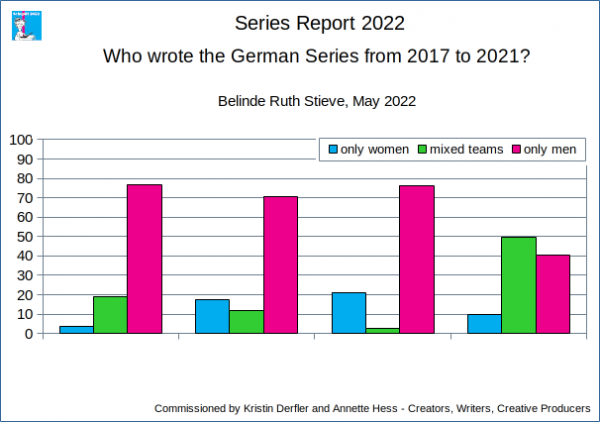
as a “study on the participation of female writers in the creative fields of screenwriting, creation, showrunning and head roles in funded and unfunded German series produced by streaming services and VOD providers, commercial broadcasters and public service television”. To give just one example of the findings: the proportion of female writers in the German TV series industry stands at only one-third, whilst that of female creators and showrunners is even below 20 per cent.
The study was publicised, and I presented the findings at, amongst other events, a WIFT Germany online event and at RTL in Cologne. Kristin Derfler and Annette Hess held discussions with media representatives and decision-makers from the television industry.
All in all, I have to say that the media response was surprisingly weak and there were no appropriate reactions from the industry either. But based on my experience since 2013 (when I started my blog SchspIN), filmmakers are not imbued with a great sense of solidarity, either within their own unions or across the board.
I asked the initiators for their assessment, four years after the publication of the series study. Kristin Derfler writes:
As far as I can see, our report on TV series has so far had little impact. This is particularly true in the areas where key creative decisions are made. Female creators of high-end series remain significantly outnumbered, and the dominant narrative perspective remains predominantly male. Whilst it is now considered good form to include at least one female writer in a writers’ room, these staff writers are rarely in the creative lead. And that is precisely what makes the difference.
Nor has the German Screenwriters’ Association (DDV) taken up the findings carefully researched by Belinde Ruth Stieve in 2022, nor has it consistently pursued the debate that was initiated. The DDV now does have an all-female working group addressing the existing gender gap, which is both right and important. However, the continued lack of equality is not a task for women alone, but should be the responsibility of the entire association.
After all, It is not just a question of who tells which stories, but also of the economic consequences of a precarious market situation. Female authors generally have lower incomes and, as a result, receive correspondingly lower royalties, for example through VG Wort. The massive slump in the industry is further exacerbating this imbalance. “Since the Covid years, significantly fewer series have been commissioned, and the scarcer the commissions become, the greater the risk that existing power structures will become further entrenched.” The debate sparked by this has been taken up and continued.
Annette Hess adds:
I can only agree with Kristin’s response. The study has received little attention; the backlash is hitting hard everywhere; gender equality is an unwelcome topic; and, unfortunately, the AfD poll results are increasingly supporting this attitude.
Personally, I’m constantly confronted with the pay gap. For my latest production in a series, I had to negotiate hard to end up with a 6 per cent higher fee compared to the series eight years earlier. On set, I learnt from two male HoD crew members, who’ve also been there from the start, that they’d negotiated a 10 per cent increase.
The same goes for funding: productions by female creatives receive at least a third less funding than those by men. For my new historical series, I actually need a budget of 18 million. I’ll never get it. It’s just a women’s story, after all…
(The AfD is a far right populist party in Germany.)
One might think, or hope, that figures providing irrefutable evidence of shortcomings would trigger a response within the industry and help bring about change; but no, that does not seem to be the case, and even when it does happen, it’s at a snail’s pace.
I began this piece today with a reference to Dorothee Schön’s internal open letter, and I’m very pleased to be able to publish it—even if “pleased” might not be the right word.
Dorothee Schön Writes to her Colleagues in the Guild
Dear Male Colleagues,
No, you didn’t misread that. I’m not using gender-neutral language here, because, for once, this letter is addressed only to the men. The women, after all, know what I’m about to discuss from their own experience. What’s this about? The DDV (German Writers’ Guild)’s current fee survey shows a veritable gender pay gap of 15% in my field—90-minute TV programs—which is greater than the gap in the automotive or construction industries.
I’m going to go into a bit more detail. I hope you’ll bear with me, but it’s necessary to make my point.
When I started writing screenplays as an HFF student in the 1980s, it was the heyday of auteur cinema. And anyone who didn’t want to direct their own films was considered an outsider. Back then, there wasn’t a single course at the HFF that dealt with film screenwriting. There were no screenwriting programs or screenwriting workshops anywhere. You had to figure it out on your own.
As a young woman, that was doubly difficult. When, at age 24, I applied for Bavarian film funding for my first feature film screenplay, *Blauäugig* (= Blue-Eyed = naive), a committee member told me to my face: “You, a woman, are not going to write a screenplay about the military dictatorship in Argentina—not with those delicate little hands.” I did it anyway; it was directed by Reinhard Hauff, starring Götz George, and was Germany’s entry for the Venice Film Festival competition.
My second script, *Bumerang, Bumerang*, about the anti-nuclear protests in Wackersdorf (North Germany), was adapted into a film by Hans Geissendörfer, starring Jürgen Vogel in his first role. The TAZ published a review at the time that I only recently came across again:
“…The political action superimposed on teenage romance is pure fabrication. Or is ‘Boomerang, Boomerang’ supposed to be a fairy tale? At any rate, this is how little Erna imagines a hostage situation. But her name isn’t Erna—it’s Dorothee Schön—and she co-wrote the screenplay with Irene Fischer. Dorothee Schön has been known, at the very least, since the no less unsuccessful Reinhard Hauff film *Blauäugig*—she wrote the screenplay for that one, too. Apparently, she’s unwittingly making a name for herself as an expert on plots she knows only from hearsay. At the same time, she’s emphasizing her own personal connection to the subject: as the mother of a young child, she was particularly affected by Chernobyl, as was her co-writer. Perhaps it doesn’t take a major catastrophe to save German cinema, but simply enough young mothers who, on Schwabing’s playgrounds, channel their creative energy not into knitting onesies but into writing screenplays.”
I was 27 years old at the time. Back then, a review like that was tantamount to a public execution, since film criticism took place exclusively in print media. Still, looking back, I consider myself lucky that so-called social media—with its misogynistic shitstorms—didn’t exist back then. I would certainly have been an easy target. Shortly afterward, when I submitted a proposal to Bayerischer Rundfunk / Bavarian Public Broadcasters, for some new “Tatort” coppers, I at least made it to the office of the then-head of television drama, who told me that while he liked my work, he unfortunately had to reject it because I’d conceived of an investigative duo consisting of a man and a woman. A female detective, he said, was simply not something the audience could accept. BR then opted for Batic and Leitmayr (two men)…
And so it went on. As my career progressed, the reservations about me were directed less at me as a person—after all, I had by then proven that I could write—and more at the topics I chose. “Frau Böhm Says No,” the story of an older female accountant during the Mannesmann takeover, was rejected: A woman over 50? No love interest? No happy ending? And something political on top of that?—No, thanks! Without actress Senta Berger’s commitment—based solely on the treatment (!)—the film, which later won a Grimme Prize, would never have been made.
Despite all those frustrating experiences, I never felt that I was at a disadvantage simply because I was a woman, since I had stoically and successfully fought my way to where I was. It wasn’t until Pro Quote collected data in 2014 on the state of contract awards and fees for women at broadcasters and funding committees that I woke up to the reality. In response to the Malisa Foundation’s figures on women’s representation in the media, Bettina Reiz, head of television drama at BR, simply remarked during a panel discussion at the time that she would gladly hire more female writers, but unfortunately they weren’t interested in crime dramas—the genre preferred by German audiences. I, who by then had already written several episodes of *Tatort*, was sitting in the audience, gasping for breath.Although everyone promised to do better, four years later the percentage of female writers on ARD’s (TV top cop dramas) *Tatort* and *Polizeiruf* series was still only 6.1%—despite the fact that 48% of screenwriting program graduates are women. So it certainly couldn’t be due to a lack of new talent. Women are now catching up. Yet currently, the first woman on the list of the most frequently hired *Tatort* writers appears at number 10 (namely, myself), and the next female colleague isn’t found until number 28.
So among the top 28 are 26 male colleagues whom I hold in high regard. Despite all that has been achieved since the founding of Pro Quote to combat discrimination against female writers, I must conclude—in light of the current fee structure and the reality of how commissions are awarded—that equality is still a long way off. The practices have simply become more subtle. They no longer tell us women to our faces as bluntly as they used to that we’re not wanted, but they continue to overlook us and our material. Except, of course, for the token women—among whom I, unfortunately, must also count myself.
And that brings me to you, dear male colleagues. What do you make of this? Are you secretly rubbing your hands with glee because you’re being given preferential treatment? Or is it dawning on you that a world where women are discriminated against isn’t actually the one you want to live in yourselves? And isn’t the one you’d wish for your partners and daughters either? Are you horrified by the state of the world, where we’re experiencing a reactionary patriarchal backlash, but don’t feel personally affected? Are you repulsed by the Weinsteins and Epsteins of this world and feel sympathy for the Pelicots and Fernandes’, but don’t see what this has to do with you?
I’m asking you these provocative questions because we women are slowly growing tired of standing alone at this Wailing Wall time and time again. In fact, I feel as though I’ve spent my entire professional life fighting my way through this jungle of resistance with a machete, only to realize now that everything behind me is threatening to grow over again…
We need the support of all men of good will.
Screenplays reflect society—so take a critical look at your storylines and characters. Ensure that women are visible in films, including those over 40. Speak up when women are being disparaged in your presence. Fight for quotas and for equal pay. Combat misogyny online. This is in your interest as well, because just like us, you want to live in a fair and just society. At least, I hope so… That’s why I’d like to conclude with a quote from Vaclav Havel:
“Hope is not the conviction that things will turn out well, but the certainty that they have meaning, no matter how they turn out.”
Dorothee Schön
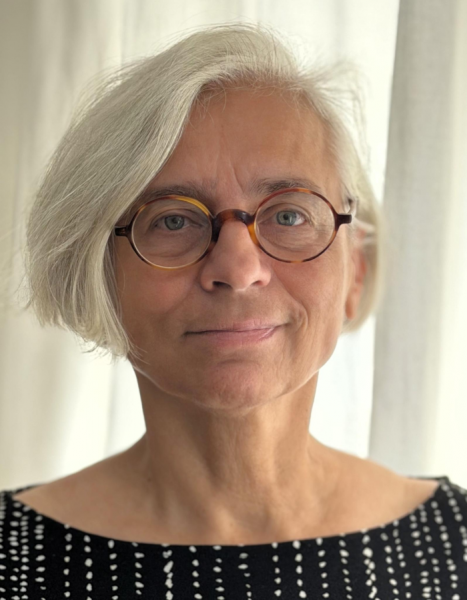
Dorothee Schön. Photo: private
When Dorothee Schön gave me the letter to read a while ago, I was quite shaken – not least because of the ‘film reviews’, but also because I wasn’t that familiar with the darker sides of a successful screenwriting career. I asked her if I could publish it on SchspIN – partly to raise awareness of it outside the DDV writers’ guild and, perhaps, to spark a wider discussion within the industry – hope springs eternal! She kindly agreed straight away.
Incidentally, I also asked her about the reactions to her letter from within the DDV so far. She told me:
“I have indeed received some feedback, though only from a few women and one man.”
Some more blogtexts on the topic:
When is it a Good Story? 25.7.22
Fair Participation? Yes it is Possible. 16.4.21