In my last blog text Rights, not Privileges! It’s that easy. I criticized the ,German’ title of the British film MADE IN DAGENHAM, which was WE WANT SEX, and half jokingly I suggested DIE AUTOFRAUEN VON DAGENHAM (the car women from Dagenham) as an alternative. This was followed by a short trialogue online:
Of course it is not easy translating titles that contain a regional reference (as was the case for MADE IN DAGENHAM), or that contain a pun or figure of speech (as is the case with DER BEWEGTE MANN or A LEAGUGE OF THEIR OWN)
But then there are film titles that are altered without much need for that, for example – another film with cars – as with DIE DREI VON DER TANKSTELLE (The Three from the Filling Station). In Sweden it is called KÄRLEK OCH BENSIN (Love and Petrol, which is quite funny really) and in France LE CHEMIN DU PARADIS (The Road to Paradise?).
So let’s start collecting! What titles do you know that were translated in a weird way? And what are your suggestions for better translations?
I’ll begin.
* interesting! Mozart’s opera is called „Cosi fan tutte“ – so in that case the tutte / all refers to females. In this case the tutti stands for males (I think)
The French expression „sage comme une image“, translates to being very good. So before attempting a new translation I would consult with the film’s authors Jaoui and Bacri.
(a comment on the translation„Tjejligan is a tricky word to translate. “Tjej” is a word for girl. “gan” is a kind of a gang, usually used when it comes to criminals. So “the Girl gang”, but in a much more badass way.“ Tack så mycket, Julia!)
(Here we go, this IS difficult. Literally it means „the man in motion“ or „the emotional man“ but then it’s a play of words, because it also contains ,emancipation movement’ as a second meaning)
UK: THE MOST DESIRED MAN
USA: MAYBE… MAYBE NOT
E: EL HOMBRE DESEADO (The desired Man, The Dream Man?)
F : LES NOUVEAUX MECS (The New Blokes) – the French sounds trés cool!
MEZCZYZNA, PRZEDMIOT POZADANIA (Man, Object of Desire)
(Dziękuję bardzo, Julita! – and the correct writing is: Mężczyzna, przedmiot pożądania. And it’s man as in male person not as in human being)
BANDE DE FILLES. (Girls Gang) Director Celine Sciamma, F 2014
USA: GIRLHOOD
D: ?
S: ?
(The film just premiered at Cannes, as far as I know it does not have a German title yet, so there’s still room for suggestions. And also I am wondering what the Swedish title will be since TJEJLIGAN is already taken.)
Sewing Machines! We need Sewing Machines! – Rights, not Privileges! It’s that easy.
Today’s focus is on two films about sewing women that are based on historical people and actual incidents. The films are no documentaries but fictionalized so of course a lot of the plot has been made up. But there are distinct differences: In Film A the characters and the depicted time gain greater depths by this and in Film B the leading lady and her achievements are reduced.
MADE IN DAGENHAM (UK 2010, German title : WE WANT SEX) tells the story of 187 women sewing machinists at Britain’s largest automobile factory / Dagenham who in 1968 protested successfully against being regraded as unskilled and who fought for equal pay. Two years later this industrial action led to the Equal Pay Act.
The TV movie MARGARETE STEIFF (D 2005) is about the life of south German sewer of soft toys and company owner Margarete Steiff (1847-1909). The film starts when she is 10 years old and ends with the 1903 toy fair in Leipzig where Steiff had her international breakthrough with „55 PB“, the world’s first movable toy bear (,Teddy Bear’).
Made in Dagenham. UK 2010
“I got brought up by my mum, me and me brothers. She worked all her life, and she paid my aunt Lil to take care of us during the day. And it was hard. Especially as she was getting less than half what the blokes in the factory was getting, for doing the same work. But there was never any question that it could be any different. Not for her. Someone has got to stop these exploiting bastards getting away with what they’ve been doing for years.”
This, in the film MADE IN DAGENHAM, is the answer of foreman / union steward Albert Passingham (played by the great, sadly recently deceased, Bob Hoskins) to the question why he is so passionate about the sewing machinists’ industrial dispute at Ford Dagenham car plant.
The film takes place In 1968, when 55,000 male and 187 femaleworkerswere employed at the car plant. The women sewing machinists produced the covers for the car seats. When a regrading of the workers led to the women becoming officially unskilled and at the same time receiving less pay, even though their work was qualified and they had to account for two years’ sewing experience, they called for an immediate stoppage and demanded equal grading and equal pay with the male colleagues, this a first in Britain’s history. This stoppage that resulted in a longer strike and industrial action, some at times reluctant union officials, who wanted to put the women’s demands to the end of the line, unsolidary workers, the miserable work place, the meeting with Labour Secretary of State for Employment Barbara Castle, as well as the finally negociated result – the machinists were regraded as semi-skilled and their wages were raised to 92 % of the men’s – all this is true to the facts.
Quite impressive! It’s always nice when a Goliath (in this story a big, capitalistic enterprise) is brought to his knees by a clever David, or rather Davina. And if in the course of this action the colleagues and husbands of the Davinas learn something new it’s a bonus.
In Nigel Cole’s social comedy all protagonists with the exception of Secretary of State for Employment Barbara Castle (Miranda Richardson) are made up and along with them their sub stories: we get to know Rita and her family and their financial problems and her son who is caned by his school teacher, shop steward Connie (Geraldine James) whose elderly husband is a traumatized war veteran, Lisa (Rosamund Pike), a historian with a University degree, who is in the role of housewife and mother as well as ornamental wife of the Ford factory boss (her son is being caned at school as well, she starts a petition which leads to his dismissal) and many more stories of private and professional dreams of the machinists, wrapped in the fashion, hair-styles and music of the changing society of the swinging sixties. I talked to representatives of trade union TUCand the library collection of trade unions’ historyat London University who both emphased the fact that the REAL Dagenham ladies had looked completely different, far less glamouros for a start. The machinists’ leader Rita O’Grady did not exist, however the real Rose Boland can be called the driving force, „but then it’s never just one person, is it“.
Reproduced by kind permission of the Financial Times
Originally the film’s titel was to be WE WANT SEX, based on a true anecdote: the machinists had painted a banner with the phrase „We want sex equality“, however they did not revealed the whole length of the banner, so the fourth word was missing. However the title was changed to MADE IN DAGENHAM, which is a wise decision since the other title would have led viewers in a direction which had nothing to do with unions’ history or rights for women. Unfortunately they chose the exact „we want sex“ title when the film came to German cinemas, in a German dubbed version. This is unfortunate for the above reason and also because the play of words does not make any sense in German. I have no idea why they did not choose a German title, maybe along the lines of „Die Autofrauen von Dagenham“ („The Car Women of Dagenham“).
Finally I would like to point out certain parellels between machinists’ leader O’Grady and Secretary of State Castle („We ain’t politicians, we’re working women – and so are you“), who even own the same cheap dress from Brenninkmeijer. Both had to fight against male prejudices and paternalism, both had to find new ways. „That risk you were talking about, I am going to have to take it“, as Barbara Castlesays to a US Ford representative who had threatened to move the car plant to another country if the demands of the women were met. I have no idea if this is a historical fact, but in fiction it is of course very nice to see politicians stand up against a big private enterprise.
MADE IN DAGENHAM. UK 2010. Director Nigel Cole, Script William Ivory. Casting Director Lucy Bevan. With Sally Hawkins, Bob Hoskins, Miranda Richardson, Geraldine James, Rosamund Pike, Andrea Riesborough, Jaime Winstone and others
Margarete Steiff. D 2005
„A cripple will never find a husband, let alone find work.“
This is what mother Steiff (played by Suzanne von Borsody) says to 10 year old Margarete in the film.
Margarete Steiff(1847-1909) suffered from polio from the age of two, both legs and the right arm and hand were affected and nearly completely immobile. She learns to write with her left hand, trains to become a sewer, buys the wirst sewing machine in her town (Giengen / Brenz, in the south of Germany), founds a felt clothes shop, invents high class soft toys, the Steiff animals, and turns her family business into a global player of the toy industry. When I saw the film for the first time some years ago I was really surprised, having owned Steiff animals all my live I did not know that they were named after their inventor. I thought they were called Steiff animals because they were stiff (German: steif) and firm. Making a biographical movie is not easy, especially if it spans over nearly 50 years as in this case. The film starts in Margarete’s childhood (there she is played by Annika Luksch) and ends at the Leipzig toy fair of 1903, when Steiff was 56 years old. The actress playing the grown-up, Heike Makatsch, was 33 years old at the time of shooting. On the next photo we see Margarete Steiff in 1895, as a 48 years old.
Margarete Steiff and Employees. Approx. 1895. Photo: Margarete Steiff GmbH.
Steiff’s biography is really impressive. A women with a poor background and a disability, a woman in the 19th century, when education and job opportunities were even more different for women and men than today. Her motto „Only the best is good enough for our children“ is quite remarkable in times when children were caned and beaten legally in schools and families. Of course (and unfortunately) the story was changed a bit. In the film Margarete is younger, thinner, more beautiful. But first and foremost: a love story involving travelling salesman Julius is made up. Why?
I was talking to someone from Steiff’s public relations staff who said that „this is what people want to watch, so this way the film will get a larger audience.“ It’s not that the love story isn’t well done, it is, and the scene where Margarete and Julius (Hary Prinz) meet for the first time on a train is quite charming, there is a good chemistry between the two of them and the dramatic arc first meeting – separation – surprise reunion – falling in love – separation – reunion – break-up works quite well. Add to that jelous younger brother Fritz (played by 4,5 years older Felix Eitner) and there you have real personal drama. But it is quite weird that this made-up love-story, or rather Julius, is triggering all Margarete’s crucial actions as well as causing the majority of turning points in this film story.
In the film Margarete met Julius on the train as she was travelling to Vienna to get a treatment for her legs.
J: Machines are the future.
M: Where I come from we do everything with our hands..
J: This has got to change. machines make everything in life much easier. For you as well!
M: But machines are for men!
J: I am trying especially to make the lives of women easier, with sewing machines for example.
Months later he comes and visits her in Giengen, he provides her first sewing machine and also the fabric for her first fancy dress which brings her big success as a dressmaker. They get closer, and kiss for the first time while swimming in a river. Julius helps her start her business and when he wants to leave after a while she says” I need you here, you are the only one who knows about machines, who knows how to oil the hand wheel (…) Stay! Julius, please!” He stays for the time being. It’s time to buy the second sewing machine. Julius leaves and does not return for days. She flipps through a fashion magazine from Vienna that of course Julius had given her. In it she finds a drawing of an elefant. Since she can’t sleep for nights on end she sews and sews and sews her “Filzelefäntles” (velt elephants), that were originally designed as pin cussions, but end up becoming the first soft children’s toy. Julius returns and bringst the second sewing machine, but in the meantime he had fallen in love with Margarete’s best friend and leaves for Salzburg with her. Margarete stops talking to her brother (because he didn’t warn her) and plunges herself into work, to forget all her sorrows, so much so, that after a short time – there is no statement on dates – she is head of a large factory with dozens of sewers. After Julius is gone only 15 minutes of this film remain, Steiff now has sales difficulties after many successful years, she reconciles with her brother and together with him invents the toy bear who is her saviour when 3,000 are ordered.
Yes, the basic facts are correct and as I said it is perfectly alright to make things up. But why the love story? To show that she is a proper woman after all? And why this Julius? To show that she would not have been able to think of all the things that eventually led to the company Margarete Steiff GmbH? Who is responsible for this decision? Scriptwriters Susanne Beck and Thomas Eifler? The TV producer? The production company?
Stories about male pioneers are not sexed-up or deflected by love stories. You may have a film on the race to the south pole, alternatively from Amundsen’s or Scott’s perspective, and there will be no female in the plot. Well, maybe Mrs. Scott (“my widow”) as recipient of Scott’s final letter before freezing to death, or maybe Amundsen’s faithful female sledge dog. When there are women they are helpful, but not significant. They make tea or contact to a financer (Hedwig Ehrlichin DR. EHRLICH’s MAGIC BULLET). But they are not the source of the men’s achievement.
But the story of pioneer Margarete Steiffis not enough for a film in its own right. Why? Because market research has revealed that a story with a heroine needs a love story? It does not matter if true or invented, happy or sad, as long as there is a male love interest? Because this is allegedly what women wnat, and men don’t watch films anyway that center around a woman?
MARGARETE STEIFF. TV movie 2005. Director: Xaver Schwarzenberger. Script: Susanne Beck, Thomas Eifler. Casting Director: Birgit Geier. With Heike Makatsch, Felix Eitner, Hary Prinz, Suzanne von Borsody, Herbert Knaup, Harald Krassnitzer, Bernadette Heerwagen, Annika Luksch u.a.
Comparing the formal frame
MADE IN DAGENHAM has explanatory titles at the beginning, like we know from other „based on a true story“- films: „In 1968 there were 55,000 men employed at Ford’s Dagenham Factory (new title) and 187 women.“, and we see archive material, old Ford promotional films from the 1960s. Even more impressive I find the end title section, in a split screen we see the usual credits, but in the other half we see the real Dagenham machinists (and Barbara Castle) back in 1968, and we see them in the 21st century, cheerfully talking about those days. Just before that a title „Two years later in May 1970 the Equal Pay Act became Law. Similar legislation quickly followed in most industrial countries across the world.” By the way, what is the situation on equal pay in the film business, behind and in front of the camera? Do women and men get the same money for the same work? Well, that is a topic for another day.
The Steiff movie passes on additional text titles at the beginning and the end. This is unfortunately, I think something like “Four years later in 1907 974.000 teddy bears were manufactured. Margarete Steiff died in 1909 from pneumonia. Her three nephews took over the management. Until today the head office of Steiff Retail GmbH remains in Giengen / Brenz.” would have been quite informative.
Despite all criticism I strongly recommend watching both films, not least because they depict inspiring stories of female sewers who through their work and their guts have considerably changed the course of history, not ony for themselves, but for many who followed.
In any case, I have just gone and bought a sewing machine for a start.
A Steiff animal and a sewing machine. Foto: SchspIN
Vor ungefähr einem Jahr habe ich unter dem Titel „Kunst und Kommerz, wo arbeiten die Filmfrauen“ insgesamt 68 Filme aus dem Jahr 2012 gegenübergestellt:
die Gesamtheit der für den Deutschen Filmpreis 2013 in allen Kategorien nominierten Kinofilme aus dem Jahr 2012, das sind 17
die Gesamtheit der für den Grimmepreis in allen Kategorien im Bereich Fiktion (ohne Serien) nominierten Fernsehproduktionen – das sind auch wieder 17
die Top 17 an den deutschen Kinokassen 2012 (deutsche Filme)
die Top 17 der 2012 TV-Charts, d.h. die deutschen fiktionalen Formate mit den höchsten Quoten
Statt Ostereiern eine Vorankündigung:
Zur Zeit ist ein audiovisueller Ableger von SchspIN in Vorbereitung,
die Reihe „SchspIN in Motion“.
Demnächst mehr an dieser Stelle. Sonnige Grüße!
SchspIN wünscht Frohe Ostern – Happy Easter by SchspIN
English Version
In place of easter eggs here’s an announcement:
At the moment an audiovisual branch of SchspIN is being prepared,
called “SchspIN in Motion”.
Stay tuned to this blog to find out more. Sunny greetings!
Cinema, Career, Children: Can the Film Industry be called a family-friendly Workplace?
This text is much longer than usual, reason being that I have not written on the (in-)compatibility of family life and working in the film industry up to now, so I had to assemble some basic data.
The other day I was reading the title story “HIM AGAIN” of the German trains magazine mobil (of Deutsche Bahn, the March issue). “Wotan Wilke Möhring is one of the busiest actors in Germany and everybody is watching him. Someone working as much as him certainly needs a little break. mobil is using it for a relaxed talk on children and career, German film and on what it feels like being on a roll.”
46-year-old Wotan Wilke Möhring has three little children and is indeed very much present on German TV and in the cinema, in 2013 we saw him in the criminal detective series TATORT, as lead in two films in the cinema, and in 6 televisions movies of the week on ZDF / German channel 2.
Möhring belongs to a minority, because he is very busy filming and because he has three children. 6 out of 10 acting people in Germany are childless, and of those with children only 14 % have 3 or more, and only 2 % have 4 or more children (Bührmann et al., 2010).
Interestingly quite a few well-known German actors have large families: Devid Striesow (4 children), Til Schweiger (4 children), Axel Prahl (4 children), Jan-Josef Liefers (4 children) and Jürgen Vogel (5 children) for example, and, a little older, Uwe Ochsenknecht (4 children) and Helge Schneider (6 children). For the top actresses in Germany it’s a different story, most have considerably fewer children or none at all, with Maria Simon and Corinna Harfouch with 4 children each as the exceptions.
Why is this? Because when dads are standing in front of the camera their partners are looking after the children, but it doesn’t happen the other way around? That fathers not neccessarily are living together with their children but mothers will most of the time, and so the careers are affected differently? That actresses have to be afraid of disappearing from the screen too long in case of a baby break, thus shortening their possible career even more? (the age disharmony on German TV results in female roles diminishing rapidly after 40, whereas male roles have their peak at 50 or 55).
There is a lot of talk about families in the German TV business whenever the programme or the audience is in focus, and in TV commercials families are a regular phenomenon. But what’s it like within the industry, how family-friendly is television as a workplace?
The Federal Organization of Filmmakers Associations held a large-scale survey last year, the results of which have been published recently as “status report 2013 – survey on the current work situation within the different branches of the film industry”. 1.543 people took part, giving a total of 22.532 answers. The report asserted that
for about fifteen years the wages of filmmakers have declined
there are less shooting days available per project
about 70 % of the eligible filmmakers have not or only seldomly had their overtime paid
many filmmakers go directly from a job to unemployment benefits II (social benefits).
This development affects everybody, but if men and women, parents and non-parents are affected differently has not been examined unfortunately. There were no questions on family status and possible children, and they did not even determined the gender of the participants in the survey.
Another survey was a bit more informative: a “nationwide survey among free-lancers and employees for the duration of the film production” (Satzer 2007) Here 871 film people talked about their working conditions, of these one third were female. This is not a representative study but at least it’s a starting point. As can be seen from Figure 1, a third of the interviewees live in families.
In this survey 56 % stated their average working day lasting between 12 and 14 hours or more. 43,7 % said that reconciling work and private life was heavily strained, 24,4 % called it very heavily strained – together it’s more than two thirds. Unfortunately these figures are not broken down to gender or parent/non-parent. These informations would be important though, because “The compatibility of family and occupation is a special challenge for many women and men. It is strongly connected with achieving equal opporunities within our society.” (Keller / Haustein, Statistisches Bundesamt / Federal Statistical Office, 2013).
Do we find equal opportunities for women and men in the film industry? Are family and film jobs compatible?
It will maybe be a little easier for an actress than a camerawoman, because as a rule she does not have to be on the set every day of production, exceptions being telenovelas for example. Also she encounters waiting periods during the course of the day. So she would hire a child care helper for the whole day and maybe take the baby along to the film set and nurse it during standby times, as actress Anneke Kim Sarnau did on the set of the POLIZEIRUF ROSTOCK (a cop tv series). Even when her second pregnancy was very advanced she could still work in front of the camera, with concealing wardrobe and subtle camera angles. How she will be able to continue in the near future with two small children is another matter. Then there is the example of actress Natalia Wörner, for whom the storyline and title of a new series was changed to include the pregnancy of the leading character (UNTER ANDEREN UMSTÄNDEN / UNDER DIFFERENT CIRCUMSTANCES).
There is a flipside to this of course, since the day/s on the set are not the only work of an actress, and there are a number film and TV projects that are not compatible with a young family, among those shooting in other towns or countries, and when children start going to school they cannot be taken along so easily, and long absences from home of the parent would be problematic. Also production companies will probably make lesser efforts for smaller parts as the actresses would be more easily exchangeable, so there the figure going with an advanced pregnancy can be a criterion for not hiring, and of course for an actress who only has a couple of days shooting in a production a quiet spot on the set for nursing and flexible pauses will probably not be provided so easily – even less so for a breast-feeding camerawoman, make-up artist or production assistant, also considering that crew members are normally hired for the whole length of a production. On top of this there may be regulations / standard operation procedures that limit the hiring of pregnant film makers depending on the amount of strong physical work.
In Germany there are a number of television programmes that have never seen a female director and others that hired only very very few (In 2013 the share of female directors in the TATORTE was only 5,6 % and in the TV movies of the week of ZDF it was only 9 %) – – so there will probably be productions where nobody in a position of power has ever thought about the working conditions for film makers with small children. But that is a story for another day.
The already mentioned long working hours are regulated in the labour agreements:
“Maximum working hours are 13 hours unless exceptional situations justify exceeding them on single days with the consent of the film makers”
(Tarifvertrag für auf Produktionsdauer beschäftigte Film- und Fernsehschaffende / Labour Agreement for film makers employed for the time of production § 6.2, valid until Dec 31 2013).
This month, on April 7, the 5th round of negociations on the new labour agreements, for which the unions demanded a maximum of 12 working hours, was successful, among other things a raise in all wages of 4,7 % and a new regulation of the working hours was agreed upon.
„The negotiations for the Basic Agreement led to resutls such as 12 hours maximum working hours. These can still be extended to 13 hours, but considerably less than before: only on up 40 % of a for a television production’s and on up to 80 % of a film productions principal photography days. On top of this breaks are extended, the main break from 30 to 45 minutes and the second pause for long days to another half hour. Breaks don’t count as part of the working hours.”
Will this agreement make a difference to parents of small children? Since there is no data from the industry available let’s have a look at the general situation in Germany (based on the sample census of 2012).
A note on the definitions: employable denotes all people in the working age of 15 to 64, these are 23,1 mio. women and 22,1 mio. men. economically active denotes all that worked in the last week before the census for at least one paid hour.
What do we see? Number one, overall there are more women than men (23,1 mio. / 22,1 mio.), but for the economically active there is a male majority (16,4 mio. / 14,4 mio.).
Number two: far more women than men are not employed (5,9 mio. / 2,7 mio.). Not employed in this context constitutes of all that are not economically active, nor unemployed / registered job-seekers, nor temporarily on leave, based on sickness, cure leave, strike, partial retirement, parental leave or maternity leave. (here I tried to translate the German terms, I don’t know how they exist like this in other countries, but it would be too much to go into this more deeply. Just two expressions: Elternzeit / parental leave in Germany describes an unpaid leave of mothers or fathers from their jobs – now there is something called Elterngeld / parents’ money to compensate this. To be on maternity leave / Mutterschutz in Germany indicates the time 6 weeks before an assumed childbirth and 8 weeks after that. During this time mothers are not allowed to work but receive their normal wages, though from two different sources).
And number three: far more women than men work part-time (6,9 mio. / 1,3 mio.). This is coherent to motherhood, two thirdsof all women working ful-time don’t have children, and two thirds of all women working part-time have children. The working hours of fathers are not affected by children. 90 % of men without children work full-time, 95 % of fathers work full-time. Figure 3 shows this in greater detail:
The first two columns show 60 % of all mothers workingand of these the majority (70 %) in part-time employments, and nearly all of the 84 %employed fathers working full-time (94 %). Then there are the rates of of employment depending on the age of the youngest child. Not surprisingly mothers with children younger than 3 years show the lowest rate of employment (31,5 %), which begins to rise again in the following years. The rates for the fathers are relatively stabile, no matter how young the youngest child.
I already mentioned the Elterngeld / parents’ money, so here some statistics on that: 95 %of all mothers of children born in 2011 claimed parents’ money, as opposed to 27,3 % of all fathers. The fathers on average claimed parents’ money – i.e. went on leave from their jobs – for 3,3 months (75 % of the fathers only took the minimal 2 months), and the mothers claimed parents’ money for 11,7 months on average (source: Federal Statistical Office 2013). Parents’ money can be claimed up to two years, this time would be shared between the mothers and the fathers.
Interim conclusion: women restrict their professional careers much more strongly than fathers do, for whatever reasons, wishes or constraints. The individual life form seems to make a difference: “unmarried mothers with a life partner have the highest rate for full-time work (46 %), followed by single mothers (44 %). But only 26 %of married mothers worked full-time.” (Keller / Haustein 2013). The last figure may have to do with the so called “Ehegattensplitting” (tax splitting for spouses), where wives in most cases get the disadvantageous tax class V, but this is only guessing.
So what can we learn from this Excursion? Well, that in Germany at least it is still mostly the mothers that are responsible for bringing up the children. And furthermore, that under the current circumstances mothers need part-time jobs.
Back to the film industry.
If children are not to be the automatic end to a career in films, what needs to be changed? Are part-time jobs even possible outside of administrations, on a film set? Can a 12-hour-day be cut in half, are part-time location managers thinkable, could two make-up artits share one job, or even directors or camera assistants? How about full-time childcare on the set, not for the children in front of the camera, but for the children of cast and crew members? How about company creches / day nurseries / after school care? And would that be sufficient, considering the working hours on a set, or are we talking of temporary children’s homes for preschool children in close vicinity? Should the production companies finance a scheme of funding single parents, so they would not only work, but actually earn money?
Yes, let’s talk about money. Not about the money these measures would cost, but about the wages in the film business. Satzer (2007) determined an average annual pre-tax income of 38.878 € for male and 30.119 € for female film makers. So according to this – non representative – survey men earn 29 % than women. This gender pay gap is also confirmed by the findings of Buhrmann and Diersche in 2012. But why is the gap so big? Are typically female film jobs paid less? Do women negotiate worse contracts individually? Is it because women – maybe because of family committments – participate in less productions per year? Knowing about the pay gap, would part-time wages for mothers in film and television even be higher than the social benefits level?
And what about women in film and television in front of the camera? According to the survey of Bührmann et al. (2010) 72 % of the women and 64,7 % of the men had an annual income of less than 30.240 € (from film, theatre and voice work). The survey also gives a more detailed classification of wages, in 5000 € steps, but that unfortunately does not differenciate between women and men. But the survey leaves another clue to the inferior situation for women: 18,5 % of the actors as opposed to 25,7 % of the actresses cannot support themselves from acting jobs.
In Germany 20 %of the women between 40 and 44 don’t have any children. What is the percentage among women in fim and television? Could that even be differenciated for the different branches of a film production? Would the rate be similar, or significantly higher? How many film people deliberately decide against children of their own and is this connected to their film jobs? We certainly need more detailed investigations on that. Who will commission them?
Another issue is the way (working) mothers are depicted on screen. In an with the Süddeutsche Zeitung Facebook’s chief operating officer Sheryl Sandberg talked about how men always tend to be characterized in more way than one, they are fathers AND experts, or politicians AND authors, whereas women can either be good mothers OR respected experts, but not both at the same time. Broken down to every day situation on television this would mean that the working mother is will always be the source of problems, stress and hysteria.” (Heide Aichinger: „Sheryl Sandberg kämpft gegen Stereotype. / Sheryl Sandberg is fighting against stereotyping“ der standard 2.4.2014)
But that is a topic for another day.
SOURCES (sorry, they are all in German, basically it’s investigations and studies commissioned by unions and statistical data and evaluations prompted by ministeries):
Rolf Satzer: „Ausgeleuchtet – Vom Arbeiten und Leben in der Filmindustrie“. 2007. Auf Initiative des ver.di-Projekts connexx-av und des BundesFilmVerbands. 871 Teilnehmerinnen (33,6 % Frauen, 66,4 % Männer) .
Andrea D. Bührmann, Nina Wild, Marko Heyse, Thomas Dierschke: „Viel Ehre, aber kaum Verdienst – Erhebung zur Arbeits- und Lebenssituation von Schauspielerinnen und Schauspielern in Deutschland.“ 2010. Auf Initiative des BFFS. 751 Teilnehmer/innen (47,7 % Frauen, 52,3 % Männer)
Andrea D. Bührmann / Thomas Dierschke: „Abgedreht und abgelehnt – Studienergebnisse zum ALG I-Bezug von Film – und Fernsehschaffenden. 2012. Auf Initiative des BundesFilmVerbands in ver.di. 375 Teilnehmer/innen (43,5 % Frauen, 56,6 % Männer).
Statistisches Bundesamt: Geburtentrends und Familiensituation in Deutschland. 2012
Matthias Keller / Thomas Haustein: „Vereinbarkeit von Familie und Beruf. Ergebnisse des Mikrozensus 2012.“ Statistisches Bundesamt, Wirtschaft und Statistik. 2013
Bundesvereinigung der Filmschaffenden-Verbände e.V.: „Status Bericht 2013 – Umfrage zur aktuellen Arbeitssituation der einzelnen Gewerke im Filmgeschäft“. Überarbeitete Fassung vom 13.02.2014. 1.543 Teilnehmer/innen (das Geschlecht wurde nicht erfasst)
Statistisches Bundesamt: Öffentliche Sozialleistungen. Statistik zum Elterngeld
Podcasts: Wer spielt im dt. Fernsehen eine Rolle? Frauenbild zwischen Fernsehrealität und Wirklichkeit
Am 22. Januar 2014 fand im Grünen Salon der Berlin Volksbühne die Podiumsdiskussion “Wer spielt im deutschen Fernsehen eine Rolle?” statt, veranstaltet von WIFT Germany.
Das Panel: Dr. Christine Otto, Drehbuchautorin, Dozentin. VDD Verband Dt. Drehbuchautor/innen Käthe Niemeyer, Regisseurin Winka Wulff, Film- und Fernsehproduzentin. Polyphon Film- und Fernsehgesellschaft mbH Anja Dihrberg, Casting Director, BVC Bundesverband Casting
Moderation: Dr. Sylvia Nagel, Regisseurin, Produzentin, ProQuote Medien und WIFT Germany [Weiterlesen – Read On]
A Look at Directors, Script Writers, Age Distribution of Casts and more
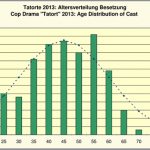
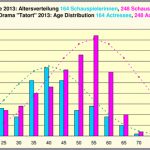
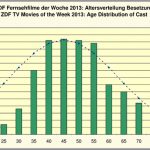
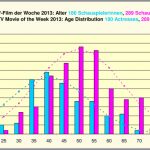
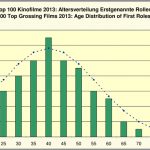
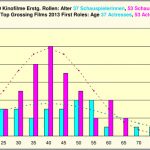
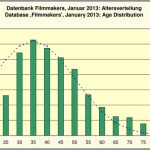
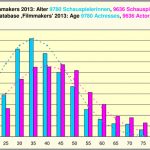
In 2013 The Cop Drama 90 min series TATORT (Crime Scene) has once again been the fictional programme with the allegedly largest audience, with an average of 9,3 Mio. per film. In just a few minutes (sunday evening, 8.15 pm) it’s time for the latest Tatort, directed by Harald Sicheritz which follows the trend of TATORTS being amen’s show:In 2013 the share of female directors went down to 5,6 % and that of the female writers down to 8,7 %, how come? Who is making the decisions? Don’t women want to work for TATORTs, or are they not being asked? It certainly can’t be for of female filmmakers, the shares of women in the professional associations is way above these low values. So it is about time the TV channels start discussing this issue in public. By the way, last week Cooky Ziesche (producer) and Claudia Nothelle (head of programming) introduced the latest new TATORT duo for Berlin, Meret Becker and Mark Waschke are going to replace Dominic Raacke and Boris Aljinovic. And once again an opportunity for an all-female cop duowas missed? Why? The TATORT is a fictional programme, so what is there to prevent two female police detectives in the centre? CAGNEY AND LACEY was first broadcast in 1981 (CBS / USA), and since 2011 SCOTT AND BAILEY haven been solving crimes in the UK (ITV), so why did the rbb (that’s the regional broadcaster for Berlin and Brandenburg) not invent the two new cops Rubin and Karow as two women, one from the west, one from the east, one married with children, one a single, one younger, one older? (these are roughly the characteristics for the woman/man cops, oh, no, not the age, they are only 3 years apart). Yes, certainly, the number of all-male duos is slowly getting less, but apart from Charlotte Lindholm (played by Maria Furtwängler) who solves crimes in the Hannover region and who paused in 2013, there a no teams without men. Source of my investigations: the TATORT listings on the webpage of the ARD (first tv channel)In 2011 and 2013 there were 36 TATORT premieres, in 2012 it were 35. Teams that went on air more than once in a year are also calculated into the statistics more than once. The next figure shows the share of womenand men for the cop teams and the main casts (chequered). By main cast I mean all the actresses and actors listed on the ARD webpage for a TATORT, minus the cops from the teams. For the teams, the share of women has risen in the last three years from 26 to just under 34 %, for the main caststhere is practically no change (38, 36, 39 %). The share of women for the population in Germany is just under 51 %.Francois Werner, in his blog Tatort Fundus, has been counting murderers and murdered in all TATORTs of 2013 (36 films with 73 people killed). I have been using his numbers and the official statistics for Germany (from the BKA / German Federal Office for Criminal Investigations) for my own evaluations, in blueish-green it’s the actual figures, in orange the fictionals from the TATORTs:On TV, in the TATORTs, far less women are murdered than in reality, on the other hand, on TV, in the TATORTs, women murder far more often than in reality. Once again: the TATORT is fiction, but at the same time we can ask what sort of fictional world in being created. And in this context it is also quite telling to look at the age distribution of the casts.In this figure all investigative teams are only listed once, no matter how often they were on screen in 2013, so we are looking at 14 actressesand 28 actors. The actresses are quite evenly distributed over the age groups. In the columns for the actors we see the senior cops on the right and the newcomers on the left. Next let’s look at the age distribution for all 36 main casts, as already stated without the leading teams. Also, 3 actors and 1 actress are missing on whom I could not find any information. The peak for these 341 actresses and actors is in the group of the 41 to 45-year olds.We get a very different and also very fictional picture, when we seperate the women from the men (with the actual numbers, the ratio of female to male roles is 1 to 1,6).The peak for the actresses is in the 36 to 40-years group, that for the actors is 10 years later, in the 46 to 50-years group. For the actresses we get – even more distinctly than in the group of the TV Movies of the Week 2013 – two slumps in the urve: for the 26 to 35-year olds, and for those older than 45. The age curve for the actors on the other hand looks quite normal, the slumps start at age 60, where at the same time actors are nearing their retirement age. Earlier on I wrote it would be interesting to hear the TV channels talking about the lack of female directors and female script writers. When they do, they should also say something about the casting lists.
And finally, yet another sad information on TATORTs: Sebastian Kempkens wrote in the taz on December 22, 2013 about the intro to the films Ein Trinkgeld für die Regisseurin / a mere tip for the female director. Many may know the famous intro to all TATORTs (have a look and a listen here: Tatort intro). But only the composer Klaus Doldinger earns money for the many many repeats of it over the last decades, the female director Kristina Böttrich-Merdjanowa does not. Indeed, the TATORT is not very nice to female filmmakers.
Kein Jahr für Regisseurinnen – die Top 100 deutschen Kinofilme 2013, die Top 20-Listen von 2001 bis 2013 und die Filmförderung 2013 (FFA)
Heute – in fünf bunten Bildern – geht es um die Top 100 deutschen Kinofilme 2013: die Genres, die Frauenanteile in den Bereichen Regie, Drehbuch und Produktion, das Alter und Geschlecht der erstgenannten Rollen. Dazu eine Untersuchung der Top 20 deutschen Kinofilme 2001 bis 2013 in den genannten Positionen, und schließlich ein kurzer Blick auf von der FFA im Jahr 2013 geförderte Filmprojekte.
Die Liste der 100 an den Kinokassen erfolgreichsten deutsche Kinofilme stammt von der Filmförderungsanstalt FFA. Auf Platz 1 FACK JU GÖHTE, Regie und Drehbuch Bora Dagtekin, erstgenannte Rolle: Zeki Müller (Elyas M’Barek). Der Film ist übrigens auch die Nummer 1 der internationalen Liste, d.h. aller Filme in deutschen Kinos 2013, mit gut 5,6 Mio. verkauften Eintrittskarten.Auf Platz 100 der deutschen Produktionen steht STAUB AUF [Weiterlesen – Read On]
Berlin International Film Festival 2014 and the Celluloid Ceiling
Today let’s have a look at the films in competition at the 64th International Film Festival Berlin and at an intervention by Bosnian director Jasmila Žbanić on gender imbalance in the film business.
Last sunday was the final day of this year’s – snowfree – Berlinale. Two events especially stuck out for me in those 11 exciting and inspring days and nights: I was lucky to get a ticket for the premiere of the Japanese competition entry 小さいおうち/ CHIISAI O UCHI (The little House) by Yôji Yamada. A wonderful film! One of the leading actresses, Haru Kuroki, was awarded a Silver Bear.
And secondly, I met Bosnian director Jasmila Žbanić, whose very impressive and touching film ESMA’S SECRET: GRBAVICA I saw 8 years ago, when it won the Golden Bear at the 2006 Berlinale.
Žbanić participated in this year’s panel discussion „Get yourself connected – a discussion on the status of women in film and gender equity“ organized by the International Women’s Film Festival Dortmund Köln, and she started the event with an intervention which I may use in this blog. Hvala puno!
But bevore we get to that here are some statistics on this year’s Berlinale competition: 20 films were in it, among them BA RI YAN HUO (Black Coal, Thin Ice), which won the Golden Bear for director Yinan Diao.Continue Reading →

 Of course it is not easy translating titles that contain a regional reference (as was the case for MADE IN DAGENHAM), or that contain a pun or figure of speech (as is the case with DER BEWEGTE MANN or A LEAGUGE OF THEIR OWN)