The Competition of the Berlin International Film Festival 2026
The Berlinale has just begun, and many of you will be watching films, standing in lines, talking shop, hanging out at receptions, and networking. It’s not easy to talk about the competition without having seen all 22 films. But so that you don’t have to talk about the tight housing market, snow, carnival, curling, or terriers instead—although the last two topics are really fine—I’m publishing a few facts and figures today that will help you shine wherever you go:
2026 will be the second Berlinale under the direction of Tricia Tuttle. I analyzed her first competition here: The first Tuttle Berlinale, February 25.
The Six Main Departments
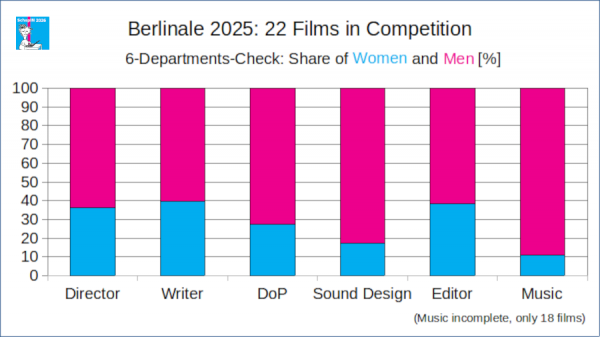
Similar to last year, the share of women in directing and screenwriting in the competition is again between 36 and 40%, with female editors also falling into this range (still below 30% in 2025). And what is remarkable is that a good quarter of the films had a female cinematographer, compared to a meagre 5.3% in last year’s competition. This year, female composers have the lowest share of women at 11.1% – although I was only able to find data for 18 films for this profession.
Sound is listed on the Berlinale website and in press materials as sound design, not as film sound engineers / sound mixers, so I have adopted this term and supplemented the positions with additional research where necessary.
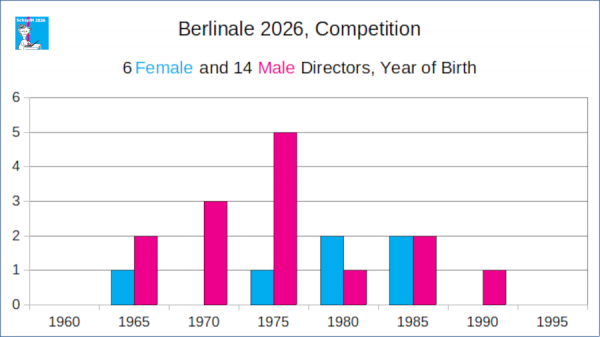
A quick word or two about the directors: in 2025, two-thirds of them were born in 1976 or later, meaning they were 49 years old or younger on 1 January 2025. In the 2026 competition, two-thirds were born in 1975 or earlier, meaning they were 51 or older on 1 January 2026. (I was unable to find the year of birth for two female directors and two male directors, all four from the United States).
Speaking of directors: ten of the 22 films are “auteur films”, meaning that one person was responsible for both directing and writing the screenplay. In another six films, the director was also involved in writing the screenplay. That leaves six films with no overlap between directing and screenwriting. These include WOLFRAM (which I will mention again later), where director Warwick Thornton was also responsible for the cinematography.
#2of6
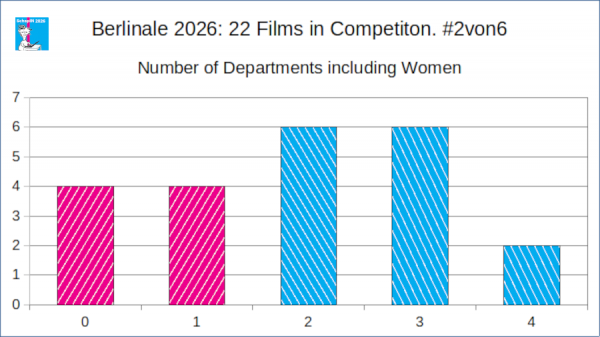
As the 6-Departments-Check suggests, a good 60% of films meet criterion #2of6, meaning that women were involved in at least two of the six departments examined, which are directing, scirpts, cinematography, sound, editing and music. Ideally, every production should reach this small threshold, but there is still some way to go.
Looking back at the 2023 Berlinale, only 36.8% of the 19 films in competition achieved #2of6. The number of zero films (no women in the six film professions) has also declined, from 7 out of 19 films in 2023 to 4 out of 22 in this year’s competition.
It would be interesting to consider the possible reasons for this. #2of6 is probably not something that was on Tricia Tuttle’s list when she invited entries for the competition. But there seems to be something that is important to her – content? Form? Visual language? – and this may also be linked to the composition of the six core departments. Or there may be a completely different reason. What do you think? (Click to contact me!)
Opening the Berlinale
Last year’s opening film was also chosen by Ms Tuttle and her team. It turned out to be a bitter-pink disappointment, DAS LICHT by Tom Tykwer (= only men in all six key positions), and its content was not really convincing either (I refer to the review by film critic Sophie Charlotte Rieger / Filmlöwin Berlinale 2025: Motherhood on and beyond the screen – in German only). The opening film for 2026 is pretty much the opposite in every respect: NO GOOD MEN by Shahrbanoo Sadat. I haven’t seen the film yet, but I’m already very excited about this romantic comedy, set shortly before the Taliban’s return to power in Afghanistan, directed by Sadat, an Afghan director who was evacuated to Hamburg in 2021, whose core team consists almost exclusively of women in film:

So what is NO GOOD MEN about – a film classified as both a romantic comedy and a drama? The Berlinale programme states:
Afghanistan, 2021, shortly before the Taliban’s return to power. Naru, the only camerawoman at Kabul’s main TV station, is struggling to retain custody of her three-year-old son. After leaving her serially cheating husband, she has become convinced that no good men exist in her country. Naru is therefore caught off guard when Qodrat, Kabul TV’s most important journalist, offers her a career opportunity. As the two criss-cross the city reporting on its last days of freedom, sparks fly between them and Naru starts to doubt her conviction. Could there be a good man out there after all?
And I should also mention that Shahrbanoo Sadat played the lead role (Naru).
There is also a huge difference between the German film funding received by NO GOOD MEN (€1.48 million) and DAS LICHT (€5.84 million). Why is that? Yes, film funding is also a good starting point for discussions about the film industry.
Participating production countries
As you know, the Berlinale is actually called the International Film Festival, so I can also offer you a few facts about the participating production countries:
Singapore is represented in the Berlinale competition for the first time with a film: WO MEN BU SHI MO SHENG REN / WE ARE ALL STRANGERS, written and directed by Anthony Chen. Four African countries are co-producers on three films – Guinea-Bissau, Senegal, Chad and Tunisia, after none were in competition in 2025.
A brief digression: I would like to take this opportunity to mention the A wie Atlas (A as in Atlas) project, ‘the largest German-language website on the subject of geography. A wie Atlas is about regional studies, special places and lots of helpful tips on maps, landscapes and books. Have fun discovering the world!’
I ended up there because I didn’t know Guinea-Bissau and wasn’t entirely sure where the other three countries on their continent were located. It’s a very informative site, and not just about African countries! Some things are still missing, such as an overview of Asian countries, but there is already a lot of information, and I found it more enjoyable to browse this site than Wikipedia. The creator is Simon Rucker, and he wrote to me that he runs A wie Atlas on his own, motivated by his interest in geography and discovering beautiful landscapes.
Back to the Berlinale and the countries represented in the competition. This time there are no South American films or co-productions, but instead WOLFRAM, a film by Australian filmmaker Warwick Thornton, who is of Aboriginal descent. You can see how this compares to last year in this table:
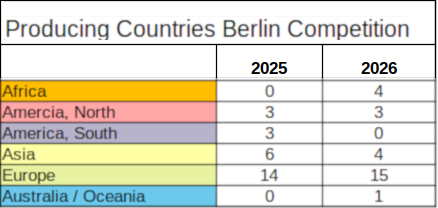
This time there were no films from China (last year there were two), and what I don’t understand most of all is that once again there were no Indian productions! If I understood correctly, 1,500 films were produced in India last year. But were none of them were ‘good enough’ for the Berlinale competition? Hard to believe. Another good question to start a debate with!
I have already mentioned co-productions. Of the 22 films in competition, seven were financed in only one country (in 2025, there were nine), including the above-mentioned film from Singapore and the German entry ETWAS GANZ BESONDERS / HOME STORIES by Eva Trobisch (German film funding: €2.3 million). Are these low-budget films that are only produced in one country? Or are films with five or more co-producing countries more likely to be low-budget, and do they have to piece the money together? I’m not actually very familiar with film funding, especially at the international level, but it’s interesting that international co-productions seem to be on the rise everywhere. (And once again, you have an icebreaker topic for the Nordmedia reception or if you meet someone from the FFA German Film Funders at a buffet).
And the “most international” co-production, KURTULUş, involved six countries: Turkey, France, the Netherlands, Greece, Sweden, and Saudi Arabia (seven countries in 2025).
Just to add: the countries involved in most films were France (7) and Germany (5) – last year it were the same two countries, with 5 and 4 films each.
A Word about Data
I’ll keep this brief, although I could say a lot more on this subject. How did I go about this competitive analysis? Most of the information on the cast and crew of the six films came from the official Berlinale website. In a few cases, I had to fill in the gaps using other sites (primarily IMDB, but also crew united for German productions, where I also researched and added up the funding amounts mentioned). Once I had the names, I then researched the filmmakers, specifically why they were men or women (or whether they might call themselves something else). I searched across the board, looking at interviews, other databases, photos from other film premieres, and so on. And that’s where I sometimes ended up with small errors or inconsistencies. For example, the sound designer for QUEEN AT SEA is Kent Sparling. However, he was initially listed as Kent Starling on the Berlinale website, which meant that I couldn’t find any further information about him. But after some cross-referencing, it became clear that his name is indeed Kent Sparling, and this has now been changed on the Berlinale website.
And then there is also the phenomenon of different information given for a position depending on the source. An example: NO GOOD MEN, where crew united (and Wikipedia, but that is not a reputable source) only mention Therese Aune for the music, while the Berlinale website states Harpreet Bansal, Therese Aune and Kristian Eidnes. And those three names ended up in my analysis table. Incidentally, many sources name Anwar Hashimi as co-screenwriter for NO GOOD MEN. But not so on the Berlinale website, so he’s not in my table either.
I actually wanted to analyse the leading roles as well, but I didn’t manage to do that in the end. But there were problems there too! Let’s take QUEEN AT SEA again. These are the leading roles mentioned on the Berlinale website, with Juliette Binoche topping the list (here’s a screenshot):
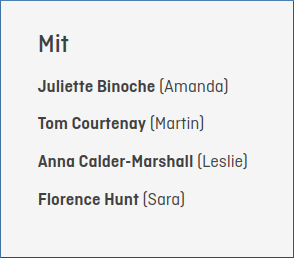
But if you consult IMDB, someone completely different is listed as the lead role – Noah Hunt Basden, and the four listed on Berlinale.de, including the actual lead actress Juliette Binoche and Tom Courtenay, don’t even get a character name. And the cast list is longer, of course. Here’s an excerpt:
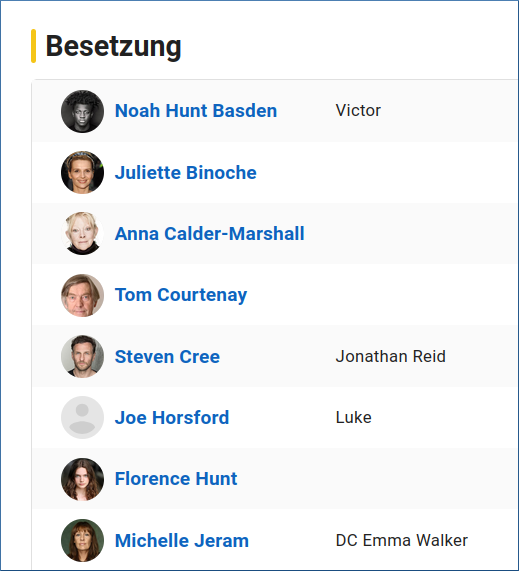
I am also familiar with this issue of role ranking from crew united, another database where actors can register themselves and mark their roles as leading or supporting roles.
Basically, it’s not that important, and film statistics don’t really have any scientific basis. But it is still surprising.
Incidentally, IMDB also states that ‘Anna Fitch is known for his work on’…
The Bears 2026
I hope I have been able to provide you with some understandable statistics on this year’s Berlinale competition and also suggest a few ideas for further exploration of the questions that arise from them.
The closing gala with the presentation of the Golden and Silver Bears will take place next Saturday, 21 February. And the next picture shows how these are cast:

The Casting of the Berlinale Bears, 2019. Photo: Berlinale.de