Last month I published my research including a 6-divisions-check on Germany‘s top cop drama (produced by German public broadcaster ARD) TATORT / CRIME SCENE 2011 to 2018 (Crimes from A Male Perspective), after my other TATORT analysis at the end of Juli on six and a half years of th show (Who‘s been Seen on the Crime Scene?) As a reminder: the development is anything but good, in 2018 only 5.5 % of TATORTs scriptwriters and 0 % each of DoPs and sound mixers were female. When someone asked me about the POLIZEIRUF 110 numbers I had to pass, because I never really looked at them before. Mainly because there are always only a handful of films per year, from which it is difficult to draw substantial conclusions. Or is it? So today, let‘s look at all POLIZEIRUFs that came out in the years 2011 to 18, individually and together with the respective TATORTs, with heartfelt thanks to Ariela and Susanne for the incentive.
Whoop Whoop, the Police is coming!
POLIZEIRUF 110 literally translates to police call 110, with 110 being the national emergency number to call the policein Germany of the past and present. POLIZEIRUF 110 is a television series from the GDR, which first broadcast on 27.6.1971 the film DER FALL LISA MURNAU. Until 1990 it was produced by the GDR television, until 1993 by DFF Deutscher Fernsehfunk and afterwards by the various ARD broadcasting stations within the combined Germany. For comparison: the first of the originally West German TATORTs was broadcast on 29.11.1970, called TAXI NACH LEIPZIG. The first decades of POLIZEIRUFE obviously were filmed in the GDR, later in East German cities. But there were and still are exceptions: Vienna (4 films), Heilbronn (3), Munich/Nuremberg (6), Offenbach (8), Volpe (8), Bad Homburg (4) and Munich (36) (all figures without guarantee, they are from Wikipedia, and that is not a 100% reliable source. More about the history of POLIZEIRUF is compiled on the ARD website).
I can only guess why there are POLIZEIRUFs in West German cities as well now. But I don’t understand why they installed one in Munich as well in 1998, because there’s a TATORT-Team already, played by Miroslav Nemec (*1954) and Udo Wachtveitl (*1958) since 1991, so far with about 80 cases.
Even though it feels like there are currently around 612 TATORT-Teams active, it’s only 22. POLIZEIRUFs are rarer, at the moment they operate in four cities: Rostock: since 2011 with Charly Hübner (* 1972) and Anneke Kim Sarnau (* 1972) Frankfurt / Oder: since 2012 Maria Simon (*1976) and Lukas Gregorowicz (*1976) Magdeburg: since 2013 Claudia Michelsen (*1969) and Matthias Matschke (*1968) Munich: from 2019 Verena Altenberger (*1987).
After recently having taken a look at six departments behind the camera at the TATORTE 2011 to 2018 (Crimes from a Male Perspective), I now present an analysis of the 100 most successful German cinema films of the last seven years, again with a special focus on the women and men heading the divisions director, screenplay, director of photography, composer, sound and editor. I have further divided the film groups, so there are studies of the Top 50 and Top 100 films, sometimes also of the Top 10 and Top 20 films. As source I used the film hit lists of the FFA, and researched the crew data at Filmportal.de, crewunited.com and IMDB.com. That today‘s images are very colourful is because I assigned a color every year without a system as soon as it appeared in the investigations for the first time, and continued with these colours. And finally: the pictures are arranged as galleries, i.e. you can simply click on a picture, e.g. the first one, and then flip through the enlarged pictures.
What Sort of Films are there?
The first illustrations show the Top 50 and Top 100 films, divided into feature films, animated films and documentaries. It’s obvious that the largest group is made up of feature films, also including quite a few feature films for children, one of them was even ranked number one in 2018 (LUKAS DER LOKOMOTIVFÜHRER), in most other years they included the various editions of FACK JU GÖTHE. Animated (Read On)
Last summer I had done an evaluation of German top cop drama TATORT, all first screenings from 2011 to the summer of 2018, I looked at six departments off-screen – directing, script. DoP, sound, music and editing – and onscreed at the first-named roles and the main casts (Who‘s to be seen in CRIME SCREEN?).
Today I have some additional statistics with the complete 2018 TATORTs, a total of 37, and some research regarding the female and male directors, like e.g. their age at their TATORT debuts and the number of TATORTs each has directed.
20 % Female Directors, how great is that?
It is nothing new to state that there are considerably fewer films directed by women than by men, and at the same time considerably fewer than the share of women among the directing graduates from film school (44 %), and also less than is their share among those active (reference: database of crew united, share of female directors is 25,3 %). This is something I have been researching and writing about since January 2013 (SchspIN – an Actress‘s Thoughts), Pro Quote Regie (Pro Quota Directing) first went public in October 2014, calling for a graded female quota for their department as well as calling for „scientific research into the development and professional situation of female directors in Germany as well as into the practise of commissioning contracts by broadcasting companies and funding bodies“, and the 94 page First Repofgerrt on Diversity by the German directing association BVR „on the share of female directors for the film and tv productions between 2010 and 2013“, published in November 2014.
Maybe a bit on the slow side is the way in which broadcasters, production companies and commissioners are reacting to this, sometimes you hear statements on a target of 20 % female directors, sometimes a lot more is achieved. And how is it with the TATORTs?
In 2018 a total of 30 TATORTs were directed by men, and 7 by women. This is a share of 18,9 % – so quite close to the often proclaimed 20 %. In the summer of 2018 the number was 19 %, so no big change in the second half of the year.
To go into greater detail, it were actually 6 female directors for the 7 TATORTs: Samira Radsi, who at 50 directed her first and her second TATORT last year, Theresa von Eitz (40) also debuted. Barbara Eder directed her second TATORT, she debuted at 41 the year before. Christine Hartmann was in charge of her 7th, her first was in 2002 when she was 34. Hermine Huntgeburth on the other hand had her TATORT debut only in 2016, 59 years old, in 2018 she directed her second, and finally there is Maris Pfeifer who directed her fourth in 2018, her debut was in 2006 when she was 46.
The average ages at which female and male directors are given their first TATORT are not far from each other, as can be seen in the following table on the left. Only the range differs, for the men it‘s from 30 (Lars Kraume in 2003) to 68 (Robert Dornheim in 2015), for the women from 33 (Katrin Gebbe in 2016) to 59 (Hermine Huntgeburth in 2016).
A big difference occurs in another context, and that is when the average number of TATORTs per male or female directors are compared. The table on the right show this, both for all directors and also for the statistics when the highest values are substracted (Claudia Garde with 11 and Kaspar Heidelbach with 20 TATORTs). On average the men directed 2 TATORTs more than the women.
A total of 17 female and 70 male directors directed TATORTs from 2011 to 2018.
… and what about Script, DoP, Sound, Music, Editing?
To start with a high number: the share of female editors is unproportionally high with figures between 50 and 70 %. What is interested is to compare these with the female editors of the top grossing 50 German feature films of 2013 to 2017, their share is quite low, between 20 and 30 %. But this is a topic for another day.
To see low shares of women it is enough to look at the following figure, especially for 2018 – the year that female directors nearly touched the 20 % mark is deplorable with 5,5 % of female writers, 0 % of female DoP and 0 % of female sound mixers.
Which crimes occur, how the stories are told and how they are visualized, all this is quite firmly in male hands. (Please also refer to my text 19 ideas for film / tv / stage, especially to the chapter #femicide-detox.
Since I don‘t want to implicate that the ARD (German public broadcaster) are determined to leave all TATORT narratives and images completely to men, or even more active, to consciously exclude women there is only room for the somewhat unsatisfactory assumption that simply nobody noticed this. This might be advantaged by the fact that in the TATORT series, a number of regional broadcasters and different production companies are involved and perhaps nobody saw the overall picture. Well, this can‘t be the case anymore from now on, because the last figure sends a clear message.
We promise to improve!
Admittedly, so far nobody has said this, but if they did that would commendable and also easy to start. Pledge to apply my suggestion „2 of 6 plus NEROPA“ #2v6pN. In other words: in every production, at least two of the six departments directing, script, cinematography, sound, music and editing should be headed by a woman (and also the NEROPA method should be applied, more on this later).
I have mentioned in the past that I see some difficulties that need to be overcome, when funding bodies, broadcasters, commissioners or others should work with more than one female quota in film teams. As far as I know there are no models that integrate quotas. Furthermore, each production is released from their responsibility, because – in accordance with the not-in-my-backyard-principle – they can hope that some other production will hire a female director, DoP or composer, and that way balance their own all-male team positions.
With #2v6pN it‘s a different matter because there each production has to do something, each production has to comply with the „at least 2 departments“obligation if they want public money or work for public television. Which two (or more) of the six departments are to be headed by women is up to the production itself. And if someone simply only want to give the six departments to men – or as happened in the case of BABYLON give 5 1/3 of the six departments to men – then of course they can do that. But not with public money.
The following three diagrams show
On the left: the number of TATORTs 2011-18 where 0 to 6 from the six departments had a woman at the top. The vertical line separates the one who passed (to the right) from those TATORT productions that didn‘t (to the left).
In the middle: to make the discrepancy more visible we see the shares of films for each year that would have passed or surpassed the 2 of 6-requirement (in the future, after #2v6pN has been made compulsory, all colums should be 100 % of course).
On the right: the table, only for 2018, shows how many, or rather how few, directors – female and male – had one (other) or more woman working in the.five positions.
Who hires the people for the departments, does the director have no say in this, or does it depend on their reputation or c.v.? Samira Radsi and Barbara Eder directed their three 2018 TATORTs with the five other positions being men-only. Both are newcomers in this format, is their a connection or was it their active choice?
Two questions I get asked regularly when I talk about #2v6pN:
“Are there really enough female directors, female scriptwriters, female DoP, female sound mixers, female composers and female editors to fill two positions in each production?”
Answer: Yes.
“Why do you only call for 2 of 6 and not 3 of 6, which would be 50 %?”
Answer: Not the same numbers of women and men are trained over all these six film professions, so a third would conform with the ratio. Therefore saying that #2v6pN favours women is untrue, it‘s just a way to help them to creative equality (and at the same time improve film quality, because if 40 % of the talent pool are ignored…..)
More female Superintendents, but still male biased casts
In June 2018 when I was writing about the TATORTs I already predicted that the share of female first roles on the cast list, which was more than 50 % in the summer of 2018, would decrease in the second half, because many of the TATORTs from the first half-year period had a lot of female coppers in the centre. And indeed, the overall share for 2018 is only 43,2 % female leads / first roles (see the next diagram). The darker blue columns, depicting the share of women for the main casts don‘t vary that much (approx. 39 %), and until someone proves otherwise I continue to aussume that the rest of the casts, with all those small, nameless parts, is even more male biased.
Apparently a focus on the leads does not do much for the whole situation. But of course, if my method NEROPA were applied (as is proposed in #2v6pN – remember, that‘s „two of six plus NEROPA“), there would be more roles for women in most scripts, even for the TATORTs. (To find out more about the method and how it works please refer to the official NEROPA website or call me, I am happy to consult and coach your production during the process).
Outlook
If things continue at this rate, how long will it take for the share of female directors to reach 44 or even 50 %? And how long, until more women are introduced to other central departments of a film team and until film casts are gender equal? I don‘t know. But I am afraid it will be quite a long while. That is why I propose the implementation of “two of six plus NEROPA“ in all film and television productions fully or partly financed with public money.
Maybe you think that the producers would refuse to go along. Are you sure? What if they don‘t get the TV slot or funding without it, would they do it then?
Are there enough female screenwriters in the first place? Yes. Are there enough female DoPs? Yes. Are there enough female directors? Yes. Are there enough female editors? Yes, of course. Are there enough female sound mixers and composers? Certainly more than zero. And also, there don‘t need to be women in all six positions in every production. But then again, that might be interesting, considering that opposite – all six departments men only – happened 63 (sixty-three) times in TATORTs from 2011 to 2018. So how about reversing this all women only?
28. January 2019
by SchspIN Comments Off on 19 Ideas for Film / TV / Stage
Producer: That‘s this damn influence of Buffalo* again! Always wanting to change everything! Author: Yes, but he is right, isn‘t he? All I wrote in the beginning, it was so whimsical and romantic, – not at all like real life. Producer: But people are romantic. They don‘t go to the cinema to see the everyday stuff they can get at home. Author: Buffalo says that the audience is a lot more sensible than we think. Producer: Well, let‘s hope he‘s right! (sighs) It‘s not that I enjoy producing schmalzy films…
* director‘s nickname DIE ZÜRCHER VERLOBUNG (1957). director: Helmut Käutner. author: Barbara Noack, Heinz Pauck, Helmut Käutner. producer: Walter Koppel.
The Pasta Parabola
A works canteen is serving noodles every day: spaghetti or ribbon noodles, cannelloni, tagliatelle or farfalle, fettucine or maccaroni, ravioli, rigatoni or tortellini. One day with meat, the next with fish or with vegetables or salad. Noodles every single day. Hmmmm! Other side dishes like rice, millet, potatoes, quinoa, couscous, french fries, dumplings, bread or papadam are never on the menu. The canteen is always full, the guests enjoy their meals. Conclusion: If people prefer noodles there‘s nothing we can do.
19 New Year’s Resolutions: What if…
A lot of people make new year‘s resolutions, like cutting down on meat, alcohol or cigarettes, exercising more, learning a new language, using their smarphones and computers less (digital detox), buying more regional groceries, supporting local businesses instead of shopping online, trying out a new hair colour or a new pub, new stuff while breaking with old habits. Many resolutions are thrown overboard after a couple of days, weeks or months, some last the whole year. Since my blog is mainly focussed on film and television, I‘ve spontaneously made a list of 19 detox-resolutions for the new year 2019 for these industries, that I am belatedly publishing today. I am looking forward to your comments and also your own (19?) suggestions, that you can leave in the comments section. Or you send them directly to the TV channels, producers or film funding bodies. And of course if you happen to be a decision-maker from the industry, how about trying out some of the resolutions in your area, for a week, a month or the rest of the year. Why not.
It‘s 2019. Time to take risks, and enjoy change and new ways. Be bold! That can be Continue Reading →
23. December 2018
by SchspIN Comments Off on Not as Cold as it Used to Be
Some years back, when I moved to Berlin, it snowed loads in winter. It was real traffic chaos causing snow. And the cold, so cold that your hands were numb all the time when you were outside, no matter how thick the gloves you wore. Actually, we haven‘t had a winter like this in ages. Pity. I really like snow.
But of course it is still cold in a mild winter like this one. Everyone who‘s had to wait at a bus stop, who‘s stood on a street corner chatting with a friend, who is working at an outdoors Christmas market will agree.
So therefore: it is not warm to spend all day outside, however mild a winter may be. It is not warm to live on the street. It is not warm to spend the night in a tube station. But that‘s what many people have to do.
Between 5,000 and 10,000 unsheltered people live on the streets of Berlin. In Hamburg there are 2,000, in Munich nearly 8,000 and nearly 3,000 in Cologne – according to estimates. A quarter of them are women. All over Germany there are more than 500,000 homeless people without accomodatons of their own, and on top of this roughly the same number of refugees in collective living quarters (according to the organization BAG Wohnungslosenhilfe). The German language distinguishes between obdachlos / homeless and wohnungslos / roofless.
For London I found the alarming figure of 170,000 homeless people in 2016 (according to The Guardian), but mostly mentions of lower numbers of people „sleeping rough“, i.e. in the streets, excluding the ones in emergency shelters for a night who are still homeless of course. I also read “figures have risen by 20 %“ but no numbers (Latest statistics show worrying rise in rough sleeping).
So therefore #bekind:
Please help! Put your small change in the pockets of your jacket or coat for easy access and not in your wallet. Collect it in your home, and every time you go out, put a handful in your pocket, so you don‘t have to look for it in your rucksack or handbag.
Give it to homeless people you meet. Those who sell homeless‘ papers, those who stagger through the tube begging for money, those who sit in the street, on the ground. How about doing this all through the winter. We can all spare some change every day. Don‘t think “They get so much already“, because that does not stop you from spending money on overprized branded products (“The company has so much already“?). Why not grant the poorest, the homeless a possible surplus? Maybe it will help them rent a bed for the next three nights. „They will only spend it on alcohol.“ Do you know this? And even if they do, well, what if that is what they want to do? Is anyone telling you what you must not spend the money on you earn or get as a present? But if this is something you are not happy with, then don‘t give money, give things. Or do both.
If you get a new rucksack for christmas, take your old one, which is probably still usable, and offer it to a person without shelter. Or bring it to the railway mission.
If you get new gloves for christmas, a warm scarf or thick socks, have a look if there are good old scarfs, gloves or socks that you can offer to someone homeless. Or bring them to an emergency shelter.
If you get a new sleeping bag and sleeping pad for Christmas, take the old ones, that are probably still usable and offer them to those in need, who sleep rough. Or bring it to the city mission.
Call your town‘s homeless initiative and as what they could use.
Give a christmas present to ‘your homeless‘ (I can imagine that most of us encounter some regularly). Buy a packet of biscuits or gingerbread, a few chocolate santas, nice chocolate or nuts & raisins, and give it to the homeless you meet on your christmas walk or last-minute-christmas-shopping.
And above all, don‘t look away. Even if you don‘t give any money, at least give a smile and a couple of words. Seeing how people who beg in the tube are treated like they don‘t exist is something I always find extremely unpleasant.
Call for help…
… if you see people sleeping on the street and you are not sure how they are doing. In Germany there are so called Kältebusse (coldness busses) that you can call when you see somebody lying / sleeping in the street. The busses carry hot drinks and food and warm clothes and blankets, and in some towns they take people to the next shelter (I listed the websites and telephone numbers for some German cties in the German version above).
For London I found the London Street Rescue:
Thames Reach’s London Street Rescue service operates every night of the year across 14 London boroughs and helps both those rough sleepers who are new to the streets and those that that have been sleeping out long-term.
Outreach workers pair up with a volunteer and together they provide practical assistance to the individuals they find across the capital. The aim is to help people into emergency accommodation such as the No Second Night Out assessment centers and hostels.
If you see someone sleeping rough in London, you can make a referral via the StreetLink website, and services such as London Street Rescue will go out to help the individual.
This is a bit strange. For one, you have to go online and register on the website to „call for help“. Then it is no immediate help (“The service aims to respond within 24-hours“). And also, calling and actually speaking with someone on the other end seems more effective to me. They can ask you back about the person in need and ask you to speak with them to find out if they actually want to be taken to a shelter and so on. I did find a telephone number as well: 0300 – 500 0914 (also with the 24-hour-reaction).
If a person needs urgent (medical) attention or you believe they are under 18 years of age please call 999.
————————————————————————–
The day before yesterday I bought a warm wooly cap. It was very nice but unfortunately it did not fit 100 %, it turned my head into egg-shape and also it was a bit too long, nearly touching my eyes. But it was really very pretty, knitted from dark-grey wool, with a cool snowflake pattern, and a soft inner lining so the wool doesn‘t itch. And it was warm. Returning from a meal with friends I looked at my reflection in the shop windows I passed. Still eggheady. At my tube station I met a woman I regularly see, she lives on the street and sometimes sells the homeless‘ paper. She is very thin, was dressed sort of warmly but not wearing anything on her head (isn‘t that where the body loses most of its warmth?). So I offered her my wooly cap, saying that she was practically new but it didn‘t fit me but maybe for her it was alright. She jokingly asked if her looks didn‘t matter that much and then we compared the shapes of our heads and she tried it on – no egghead! It fit perfectly. Then she told me that some years ago she was given a wooly cap at a shelter, used but washed, but then she contracted lice from it. Of course I was feeling ba, because we haven‘t had warm water in our house these past two weeks, and then of course you don‘t wash your hair that often or that well. Anyway, after inspecting the cap she took it, it warms her ears and she looks really nice in it, much nicer than I did. Cool!
Merry Christmas – and let‘s make it through the winter alright, all of us!
Here‘s a new christmas song, CHRISTMAS IN BERLIN, just released by an Australian in Berlin, Justine Electra:
11. December 2018
by SchspIN Comments Off on THE SPLIT – Diversifying Casts
Today‘s aricle is about promoting diversity on-screen, NEROPA, the ethnically diverse cast of the British divorce law miniseries THE SPLIT (BBC, 2018) and my colleagues Fiona Rodrigo, James Krishna Floyd and Samir Fuchs.
Many years ago a casting director put me forward for the role of a nurse, but I was rejected on grounds that that was not what a nurse looked like. Really? If I had become a nurse instead of an actress, then at least one nurse in Germany would have looked like me. “No, but not on television“. Recently I was rejected for the role of a social worker, because of “too old“. Seriously? Do they stop working when they reach fourty?
Not fitting in the picture is something that many acting colleagues, born and raised in Germany like me but with a visible migration background, experience as well, probably more often. “Without an explanation I can‘t just cast you as [role ABC]“. Without explaining what? The perfect Bavarian dialect? A certain profession? The normality?
New Faces
It is imperative to create gender equality onscreen in order to reflect the world in which we live and to inspire us all. It won’t do any more to tell societal, political, social, private, futuristics stories from a male perspective with eternally male biased onscreen ensembles. Actually, this was never alright, but common practice.
Variety not only includes (more than two) genders but also various appearances and differing living realities of people. And they should not only be visible when they are at the centre of a narrative – a blind teacher (PEAS AT 5:30), an accountant of Pakistani heritage (AE FOND KISS), a pregnant woman (ROSEMARY‘S BABY), a deaf young woman (CHILDREN OF A LESSER GOD), an overweight bride (BACHELORETTE) or a struggling unemployed (I, DANIEL BLAKE). They should also appear as supports or even extras – as far as it fits the story. To use the example of a fictionalization of the cardinal convention to elect a pope: there will be younger and (mainly) older men, white or any other colour, fat and slim, wearing glasses or using walkers. But no women. And no openly gays.
However the standard for scripts and especially for casting – not only in Germany – seems to be oriented towards white, young, more or less good-looking, slim, heterosexual women and white, young and old, good-looking to ugly, slim to very fat heterosexual men.
Gender (Script) and Appearance (Casting)
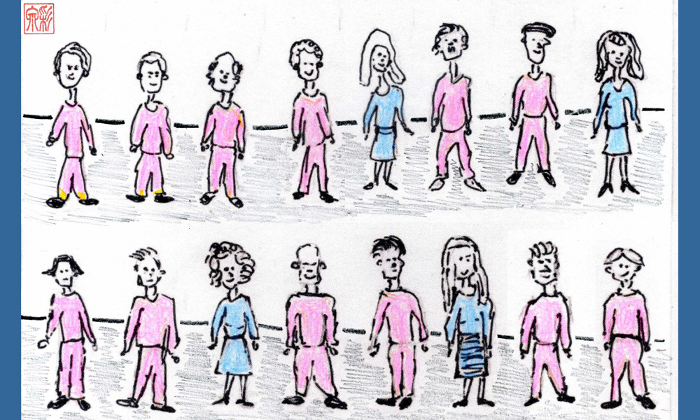
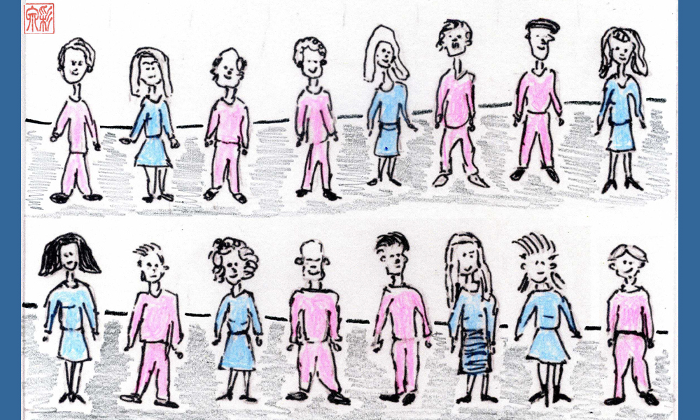
I invented the method NEROPA Neutral Roles Parity to raise the share of female roles in scripts by that simple, non-invasive way of identifying theneutral roleswhose – mostly male – gender is not essential for the story. (as a side note: I am not calling for a 50 %female quota or target for every film, but am suggesting a method that can be applied by every production right away and that help – e.g. alongside commissioning new ideas and formats and applyingNEROPA during Script Development – shortening the road to gender parity onscreen.)
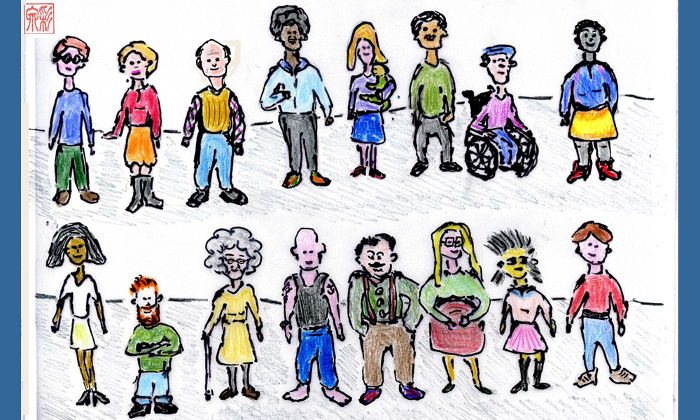
To further diversify the onscreen characters I suggest as a second step using the NEROPA Finetuning, which is a task for the competent hands or minds of casting directors. Actively, i.e. with an announcement („Do this!“), and with the necessary freedom of action, trusting that they can propose great, varied and exciting casts and ensembles. Because they know all the actresses and actors, not only the broadcasters‘ shortlist of TV faces and a handful of „leading roles suitably“ names.
The next images demonstrate the effects NEROPA can have: Image 1 shows the original male biased situation, image 2 with more female roles as a result of NEROPA (see NEROPA Method), image 3 the roles after casting of actresses and actors (see NEROPA Finetuning).
A few weeks ago I was urged to implement a quota for ethnic diversity into the NEROPA method. As important as I think a wide-ranging representation is, I don‘t think setting up quotas for the characters in a script is the best way. Diversity, including ethnic variety – independent of plots and character breakdowns with specific descriptions – is a question of who is casts, so it‘s the work area of casting directors.
And there is something else that I find is worth a thought: it‘s not only people affected by racism that are underrepresented in film and television, there are so many others, individuals and groups, for example people with disabilities, LOGBTQI, old people, older women, overweight people, socioeconomically poor people and and and. Should they all be worked into the scripts according to their percentage of the population? That seems highly bureaucratic and uncreative. And it is not something that would or could work for every story, every period of time, every setting.
And also, it is quite difficult or even impossible to get different proportional quotas or targets under one roof. I find it quite striking that other than for female directors, there haven‘t really been any concrete demands or suggestions to raise the share of women in other film departments. The model #2v6pN is an attempt in this direction and involves the heads of department for direction, script, DoP, sound, editing and music (see also Germany’s Top Cop Drama TATORT on and off-screen 2011 to 2018). But we definitely need more ideas urgently. Also because raising the share of female directors is not enough and would automatically lead to substantially more female heads of other departments and more female roles.
It’s All in The Mind
A basic question when casting roles without information on appearance, body shape, ethincs etc. in the script could be: “Does this character need to be white, young, good-looking and able-bodied?“ Of course casting directors have already done this from time to time with minor characters, just like they have been gender-switching roles, and producers have been open to this. In NELE IN BERLIN casting director Uwe Bünker cast black Swiss actress Jennifer Mulinde-Schmid as a nurse, both attributes weren‘t in the script. In LAST TANGO IN HALIFAX (casting by Beverley Keogh) there is a lesbian teacher, Kate, in the script. But was she also described as black, or was that something that happened when Nina Sosanya was cast, and they wrote it into the script afterwards? (though I have to say that I only remember one piece of dialogue where this was being talked about).
I can imagine that a production already working with the NEROPA method will also be more open to a more diverse casting. They will be talking about gender-switching and representation, about stereotypes and new images. So theoretically we can assume a readiness to change a few of the male into female roles. It doesn‘t seem a far stretch from this to the order “Please also propose a few people, less common onscreen but very much present in real life”, taking into account the regional setting and period, and if necessary providing data on population etc.
Apparently the situation in the UK seems to differ from ours in German. There casting directors are working mainly autonomously and can decide – with the exception of prominent leading roles – on the actors and actresses. Here in Germany I hear casting directors mention a worsening work situation, less competences, less time, deadlines, less money for auditions and so on, with decisions on final scripts and role lists being available later and later. But it shouldn‘t have to stay this way.
With the necessary backing and willingness in a production a film can be diversified considerably through the casting and so become more modern and more attractive for a larger audience. This also helps avoid stereotyping. If there is only one representative of a group, they are often presented in a clichéd manner. If for example there is a Swedish woman in a British film, chances are relatively high, that she will be cast with a blonde, busty, tall woman. If there are three Swedes, may one of them will have black hair and be an immigrant. Supporting roles also offer another chance: I often see that in films with a person in a wheelchair as the lead, there seems to be a tendency on the negative (how many films do you know where the ones in the wheelchairs want to end their lives?). If it‘s a big or small supporting role in a wheelchair, the registrar, newspaper editor, the neighbour or mother-in-law, we see normality. Because then no tale of woe has been written as their backstory.
THE SPLIT: Equality and Ethnic Diversity
There is an interesting example for a series with strong ethnic representation, it‘s the 6-part-series THE SPLIT (BBC 2018., created and written by Abi Morgan). At the centre there is a family of divorce lawyers. The oldest daughter Hannah (Nicola Walker), married, 3 children, just left the successful family business (Defoe) for a competing enterprise (Noble & Hale). Mother Ruth (Deborah Findlay) and middle daughter Nina (Annabel Scholey) remain at Defoe‘s, Rose (Fiona Button), the youngest, works as a nanny and plans to marry (see BBC website).
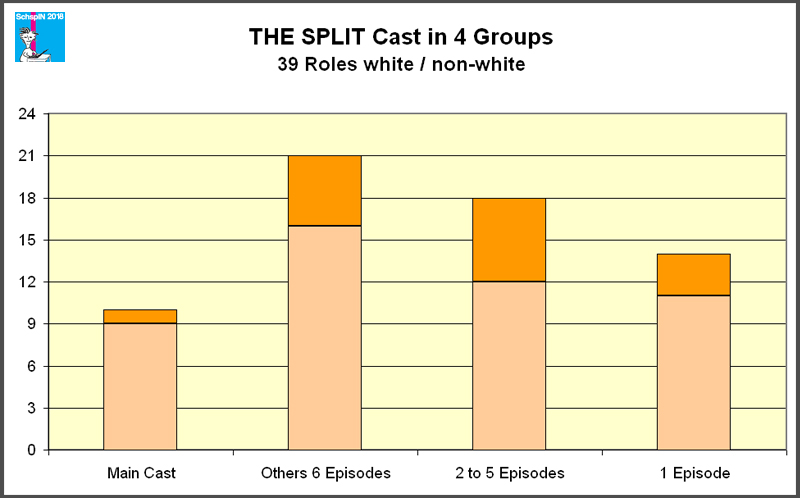
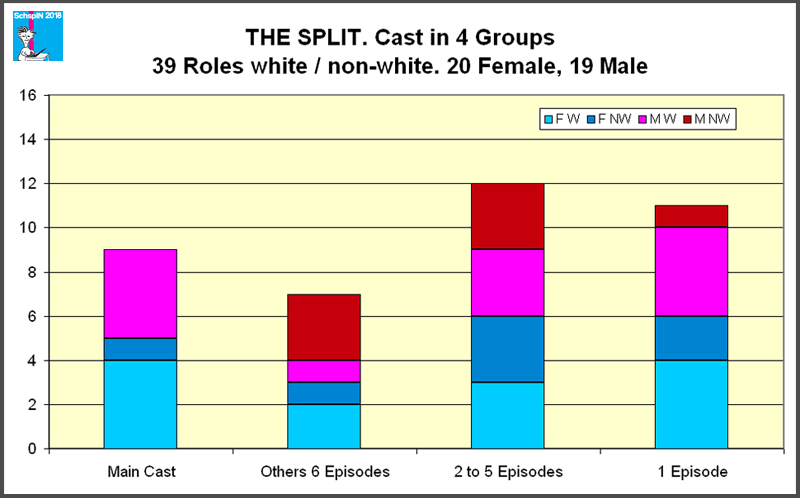
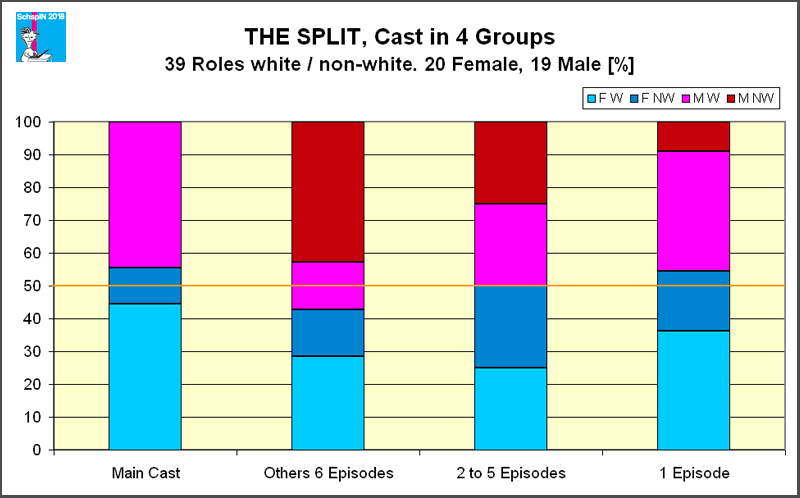
The main cast is quite gender-balanced, and we see women of different ages in bigger and smaller roles, there is a female foreign secretary (Claire Rushbrook) and a female PM (mentioned). But what makes this cast stand out is the strong representation of non-whites. Just like that, I would guess. Actually I‘ve tried to find out how this came about, whether the producers issued a guideline or target: Diversity! – Let‘s cast more diverse. Unfortunately, Sister Pictures and casting director Beverley Keogh haven‘t written back to me yet, bus as soon as they reply I will add the information to this article. The only role that was probably written as black might be footballer Diallo Diapo (Thierry Mabonga) who comes to the law firm about a prenuptual agreement.
Otherwise we see Rose Defoe‘s fiancé James Cutler and his parents Annie and Miles, played by Rudi Dharmalingam, Shobu Kapoor and Ahmed Jamal, and vicar Glen Peters (Kobna Holdbrook-Smith). Other non-whites include Hannah‘s colleague / assistentant Maggie Lavelle (Ellora Torchia) and legal assistant (?) Sean Bainbridge (Afolabi Alli) as well as rich businesswomen Goldie McKenzie (Meera Syal) and Jaynie Lee (Tamara Lawrance), and of course Alex ,Zander‘ Hale, head of Noble & Hale (Chukwudi Iwuji). It is not important if he is black, white or brown – and actually, to me „Zander“ sounds a little Dutch, quite contrary to lawyer Christie Carmichael, whose name seems very English and not in the least Dutch. Christie is played by Dutch Barry Atsma und in the dialogues they refer to his nationality a number of times. I find it quite nice by the way, that a foreigner is for once played by a foreigner. The few Germans we see (mot only) in British productions of today – contrasting the many Germans who‘ve come to live and work in London and other British towns – are usually played by British, often with this parody of a German accent, instead of casting German actresses or actors or having them at least dubbed for the German dialogues afterwards. Queen Mary, a German grandmother of Queen Elizabeth II, would have been fluent in German and without an accent – unlike what I heard in the TV series THE CROWN). But that is a topic for another day.
The next diagrams show the share of white and non-white cast (in number and percentage) among the continued and smaller roles, on the whole and broken down for gender. These are quite realistic figures for a series set in London where 44 % of the population belongs to an “ethnic minority“. Und British divorce law is a quite female domain.
However, there‘s not much there when you look for other types of diversity in the cast of THE SPLIT. We can take foreign secretary Emma Graham (Clair Rushbrook) who is quite big in an ensemble of otherwise slim women. There is one pregnant woman (part of the plot) but I don‘t remember anyone with a disability (if we count out people needing glasses), no hint that anybody might be LGBTQI, which would need to appear in the written script – because it‘s not something you make visible by casting a certain actor or actress. Actually, I read there is to be a second series, and if I had to put money on who might turn out to be a homosexual, it would be on Zander Hale, – as we haven‘t learned anything about his private life yet. (Oh, and who is this Noble of Noble & Hale? Different topic).
I also noticed something in the cast which is quite common in Germany as well. When well-known actors / actresses are cast, age logic is overruled. We just had a new German TV series called DIE PROTOKOLLANTIN, where leading actress Iris Berben (b. 1950) and Moritz Bleibtreu (b. 1971) are cast as sister and brother, in flashbacks we see them as children, some 5 or 6 years apart. In THE SPLIT it‘s leading Hannah Stern, oldest of the three sisters. According to the dialogue she is 4 years older than middle sister Nina, in real life actresses Nicola Walker and Annable Schorley are 14 years apart and it shows. Generally speaking, the three sisters don‘t really look very much alike, and also their accents and ways of speaking differ considerably (I have to say, I am a foreigner, so maybe I am completely off there). I have sisters myself and to this day we get mistaken for one another on the phone. But of course, this is not the focus of the series, it works as it is, even without family resemblance. I heard that there were complaints about another BBC series – BODYGUARD – about the high percentage of black or mixed-race actresses and actors. Strange. That series is also set in London.
Ethnic diversity in a cast.
Catching Up with Reality – Three Acters
Comparing the names of the characters from THE SPLIT with those of the actresses and actors shows that you cannot always guess a person‘s background from their name, and aren‘t our photos and showreels more important than our names anyway?
My colleague Samir Fuchs, whom I met in the German family TV show DSCHERMENI last year (IMDB) – he played a refugee and I the manager of the refugees home – was born and raised in Berlin. Apart from „Berlinerisch“ his mother tongue is German, Samir does not speak the mother tongue of his father who came from Eqypt. Since he looks more like him than like his blonde mother he is never cast as a „Berliner“, but more often than not as an immigrant, as someone who only speaks broken German. Or Arabic. For that he has to work with language and dialect coaches. If he is cast as an accent-free German, there is usually some sort of comment in the dialogue: „But he was born in this country, you know“. I asked him how the industry reactos to his name. Fuchs is German (meaning ‘fox’) and Samir is an Arabian name (meaning ‘conversation partner in the evening’) – but then first names are often international:
Mmhh, atually quite a few people think I use a stage name. I am probably the only one with this name in the whole world. For my work, it‘s actually a Unique Selling Point, easy to remember and from my experience I‘d say, with a positive touch. German casting directors know my work and at least know what to expect visually when I come through a door. What sometimes happens in an audtion is that Herr Fuchs emerges more one moment, and Samir in the next. Like a curse and saviour at the same time. A bit like a hybrid car. You have to know which source of energy you want to use in the moment.
There‘s a British actor whose name was James Floyd, when I saw it for the first time in a film‘s end titles (MY BROTHER THE DEVIL, directed by Sally El Hosaini). On my blog I have actually mentioned him before, he is Dr. Varma in the British TV series THE GOOD KARMA HOSPITAL, set in India, filmed in Sri Lanka, in the article Taking a Shower – The Dramaturgy. Last year James added his second ‘first’ name to his professional name. He kindly gave me permission to quote his statement from Oct 6, 2017 (thank you!):
From today my professional stage name will officially be James Krishna Floyd. This is my full birth name, with my middle name, Krishna, included.
I have done this for many reasons. Here are a few:
When my mum was a teenager she travelled by car, with her family, from Tamil Nadu, South Indian to London, UK. She then stayed in London and has been based there ever since. She met my English dad during Flower Power and the hippie movement of love and acceptance. I am a very proud mixed race human and have many cultural influences in my DNA. But the one thing I am most proud of is being the son of a migrant. (…) If we go back far enough every human comes from migrant blood.
London based English actress Fiona Rodrigo is of Sri Lankan heritage. When I asked her about reactions to her name (Fiona doesn‘t sound Sir Lankan and Rodrigo neither English nor Sri Lankan) she replied:
It has been suggested that I change one or both of my names but mainly Rodrigo because, for example, I have been mistaken for being from South America or parts of the Mediterranean. I love it but it is possible that my name has been preventing the industry from seeing me for South Asian roles when an emphasis has been placed on a very particular definition of authentic casting. I am encouraging the industry to catch up with reality.
Portuguese surnames are not uncommon in Sri Lanka apparently, from where Fiona‘s parents came to England several decades ago. What I also find strange about the reactions she gets is that they focus so much on the name. Also, she could have just changed it through marriage. I asked Fiona how often she auditions for parts that have some or no reference to South Asian appearance in the character breakdown, and if she often has to fake some sort of South Asian accent:
Far more recently the roles have been South Asian specific and have required an accent – both for theatre and screen. A few screen auditions have been for a British or American characters and have not specified any ethnicity and these have been via self-tapes. I love a mix of everything because I am and that is also the world. This is what the world looks like. I can be Sara, Anna or Sharmila. As an actor you want, and expect, to be limitless and play it all.
(what can I say, I didn’t get photos I could publish on my blog…)
Fiona added:
Commercials seem to be far wider in the casting. For commercials often I am one of many different ethnic looks in the audition which is great. I usually use my natural accent and there are typically no limits on who I can be. I’m hoping that self-taping and a continued push for inclusive casting will continue to open this up much more so the overall casting process itself is actively widened and representative of the real world.
See also: Fiona Rodrigo: Do I have to change my name to be seen for South Asian roles? (The Stage, 3.8.18). I asked Samir about the roles suggested to him: better be an eyes-rolling translator or a terrorist with poor German than no work at all?
Clichés are made by people. Films as a mirror of social conception visualizes them. I made my first fim shortly after 2001. The already stereotypical and negative perception of foreigners has been extremely intensivied since then. At the expense of ethnic or religious groups films and TV series are produced that often reinfoce this perception. As an actor I have a social responsibility and at the same time I have to earn my living. To counteract stereotyped ideas such as „a long beard points to an imminent act of terrorism“ I try to humanize the characters I play in such a way that the audience sees their actions, and maybe condems the individual role, even hates them, but leaves out their ethnical background. At least this is what I try to do. It‘s a small line to walk, especially if the scripts lack a certain depth, I am well aware of that. It is very important to work with good people who are prepared to rewrite parts of a role. So that a „Lebanese crack dealer“ is transformed into a „tax consultant“ who mucks around with the police. Quite the foxy character! (note: Fuchs, Samir‘s surname, is German for fox)
What about working as a dubbing actor, is it mainly Arab characters with heavy accents?
I came to dubbing through a colleague. They were looking for someone who could speak German with an Arabian accent for the wonderful Danish film ADAM‘S APPLES (directed by Anders Thomas Jensen). I went to the auditon and thought that I was terrible, speaking with an accent felt so artificial. Despoite this I got the part. Then I got better known through word of mouth and so I made a virtue out of necessity, trained my Arabic and worked on accents. Nowadays I am booked for dubbing characters with Arabic roots, also because I seem to be understand the original actors better. I have acutally become a specialist for those cases which are too difficult for German tongues, but I also dubb a monk, a literary professor, Marco with long blonde hair and your normal next-door family man.
I‘d like to conclude today‘s article with the rest of James Krishna Floyd‘s statement from Oktober 2017. which spans from his family over current right-wing politics to our responsibility, with a hopeful ending:
But the one thing I am most proud of is being the son of a migrant. My family has always been very active in its support for immigrants and the underclass in UK. From teaching English to refugees to working with young offenders on probation. If we go back far enough every human comes from migrant blood. Yet still today so much of mainstream society condemns immigrants and immigration. From the orange ape that is Trump who rescinds DACA and does everything he can to vilify immigrants, even though his great grandfather was a German immigrant in US. To show business, the industry I’m in, that pats itself on the back every year for handing out crumbs to what it calls ‘minorities’ in the name of ‘diversity’. To the evil brothers of UKIP and Brexit that have duped many Brits into thinking that running away from the (albeit imperfect) global community of EU will benefit our future generations. To the Alt-Right movement being anything but alternative and frequently wrong, especially on immigration. I could go on but I wont. I am not religious but Krishna was a Hindu God of many things, especially compassion. I hope in some tiny way, my new stage name can communicate this. We must have compassion for the migrant journey. It’s where we all come from. Peace and Love, James Krishna Floyd
If you follow this blog you may be a bit familiar with the goings-on at the BFFS, the German Acting Union, on an organizational level, and also in relation to several topics and the economically trying situation of the majority of actresses and actors, as I‘ve written about it several times in this blog:
Today marks the start of the election for the new board. For the first time this is done via an online vote, but for whatever reason over a period of 11 days. Alternately members can vote via normal paper mail. So why the 11 days? But that‘s not the only aspect which is a bit problematic. It has been decided – through a change of the statutes at a general assembly which was attended by only about 30 of the around 3,000 members of the union – to hold the vote as a block election, or a team election as the current board likes to call it. Teams of seven can put themselves forward as candidate teams, if they are put together in a fashion that regards the four different membership groups of the union: stage, film, television and speech (dubbing etc.). A mix is a good thing, obviously also a gender mix (which the teams are to aim at) and possibly also a mix of old and new candidates. However, there is only one team that the actresses and actors can vote for (with yes and no, and maybe abstention). Does this come as a surprise? Not really. Because even if there are individual members that want to be candidates, and who have worked in the union, maybe at a regional level, for years, it is really not possible for them to find 6 others, and why should they? At the same time, who would vote for 7 complete newcomers to the board? It would have made much more sense to have individual votes and let the members decide on the make-up of the new board. Instead, it were the „old guys“, men who have been on the board practically since the union started, who picked and chose the new additions to their team.
Today the voting starts, and today an open letter by 21 members was published criticizing the procedures, and announcing that they (or rather we, I also signed the letter) will vote with no, because a vote without choice is not a proper election, because the one team has not really announced any sort of political agenda for the term of four years, and because it is strange that the online election is done over 11 days, why is this?
You find the original open letter (in German) in the upper half of today‘s text. I haven‘t had the time to translate it yet but hope that I brought across the general intention.
Today I heard from some British actress colleagues that they are still waiting for the introduction of an online vote – Equity UK does the voting via letters – as they think that might increase the percentage of participants. But they wouldn‘t do it over 11 days and of course they don‘t have block elections, at Equity you vote the representatives and councillors (and as far as I know also the members of the committees, am I right there?) from a long list of candidates.
Here‘s hoping that we in German will come to that as well at the next BFFS election – which will hopefully be held in spring 2019 – after the momentary election has been anulled.
15. November 2018
by SchspIN Comments Off on Two German Series: BABYLON BERLIN and CLASH OF THE FUTURES
This text is about two German TV series, set between the two world wars in Germany and other parts of Europe. Unfortunately I haven’t done the English version yet but hope to do so soon, at the latest when the TV series KRIEG DER TRÄUME / CLASH OF FUTURES is broadcast in English speaking countries. BABYLON BERLIN apparently has already been screened by Sky Atlantic.
27. October 2018
by SchspIN Comments Off on Touring the Irish Isle – #WakingTheFeminists
A couple of weeks ago, invited by Irish Equity and Equity Scotland & Northern Ireland, I presented my gender diversity tool NEROPA in front of representatives from theatres and the film industry in Dublin and Belfast.
Today I want to give a very brief account of my days on the green isle and introduce and thank the people who made this all possible. Also I am very happy that the two great ladies who gave the key note introductions at the events – Sarah Durcan in Dublin (“We need to Talk about Power and Representation”) and Maggie Cronin in Belfast (“We have Come a Long Way and still have a Long Way to Go”) – have kindly given me permission to reproduce the bigger parts of their speeches.
Bringing NEROPA to Dublin und Belfast
As some of you may know, since shortly after I started my analysis and blogging, I have been in regular contact with Jean Rogers of Equity UK (read my interview with her Well done, sister Equity! from 2013) and half a year after I published my method NEROPA Neutral Roles Parity in January 2016, I met Jean and other female film activists at Equity in London (read SchspIN in London). And eventually, this January, initiated by Jean Rogers and the Women’s Committee, Equity UK and the BFI held a NEROPA symposium in London.
Not too long after this I was contacted by Lorne Boswell from the Equity Glasgow office who suggested an Irish / Northern Irish double act with NEROPA and introduced me to Karan O’Loughlin of the republic’s [Weiterlesen – Read On]
26. September 2018
by SchspIN Comments Off on Cleverer Girls
School girls are better at school, they are more likely to skip a class than school boys, who often even have to repeat classes.
What do I base this premise on?
On an analysis of the age of students when they take their A-Levels (or rather the German equivalent, the Abitur). Male pupils are usually older than their female classmates, which means that they probably had to repeat a year or two, or maybe started school altogether a year or so late. So maybe they are not neccessarily more stupid, but just late bloomers who take longer to learn things. The female pupils on the other hand are really good at school and skip one or two classes on their way to the Abitur. Of course there are exceptions to the rules in both groups.
There are two contraints though: for one, this is not a theory for the 21st century. And on top of this, it only refers to fictional school graduates in film and television.
“Klassentreffen” is the German word for Class Reunion.
There are two new class reunion films out in Germany this year, KLASSENTREFFEN 1.0 – THE UNBELIEVABLE Continue Reading →